
Reviewed · WALKING TOURS
Hiroshima Peace Park & Atomic Bomb Dome Guided Walk
Two hours, many lessons, one quiet walk. A guided tour through Hiroshima Peace Memorial Park connects the big story of August 6, 1945 to the smaller, human details, step by step. You’ll pause at the Fountain of Prayer and the Atomic Bomb Dome, with a guide who keeps the meaning clear as you move.
I especially like the way the tour uses key monuments as a timeline, not just photo stops. The Peace Memorial Museum visit helps you understand what you’re seeing outside, and it makes the symbols around the park feel less abstract. You’ll also get thoughtful, patient explanations from the live guide, Adina, who can explain the science side in plain language and slow down when you need it.
One consideration: this is a solemn, mostly on-your-feet walk. It moves quickly from point to point, so plan for standing, walking, and quiet moments, and bring water and sunscreen if the weather is warm.
Key moments you should look out for
- Gates of Peace as your warm-up before the memorials get heavier, so you start with the park’s theme of unity
- Dr. Marcel Junod’s monument to highlight how medical help reached survivors, not just the explosion itself
- Peace Memorial Museum storytelling that frames August 6, 1945 with context you might miss on your own
- Children’s Peace Monument and Korean Victims Memorial for remembrance that includes victims often overlooked in quick visits
- Peace Bell and Peace Tower as a public act of hope, not only mourning
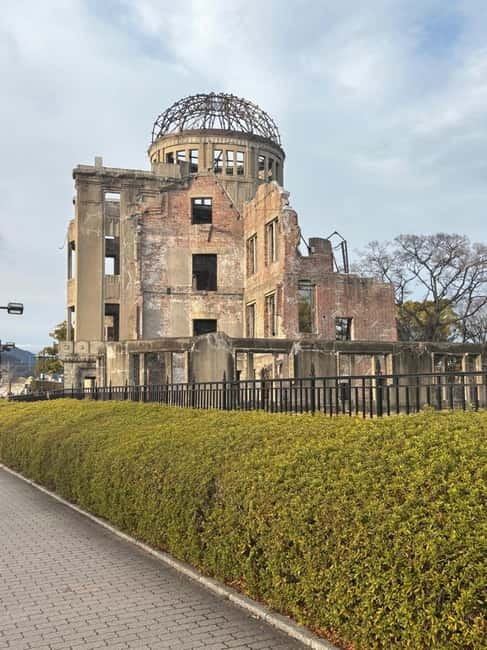
- Atomic Bomb Dome and Hypocenter Monument where the location itself becomes the lesson
Meeting at the Gates of Peace, then walking on purpose
You meet at the Gates of Peace, in front of an Italian restaurant near the park entrance. The location is easy to find once you’re there, and it’s a smart start point because the first thing you see is the idea of peace and unity, not just devastation.
The walk is designed for a total time of about 2 hours, with short guided segments at each stop. That structure matters. The park is packed with memorials, and if you go solo, it’s easy to get stuck reading signs while others stream past. Here, the guide keeps you moving at a respectful pace, with enough time to stop, look, and understand.
The guide is live and speaks English, Urdu, and Hindi. Adina leads this tour, and the big advantage is how he explains things clearly without making you feel rushed. In my kind of travel style, I like when a guide can switch between big-picture history and specific meaning, and that’s what this walk is built for.
More Walking Tours in Hiroshima
- Hiroshima Historical Walking Tour – Why A-Bomb was Dropped
★ 4.8 · 893 reviews - Hiroshima Peace (Heiwa) Walking Tour at World Heritage Sites
★ 5.0 · 872 reviews - Hiroshima City 4hr Private Walking Tour with Licensed Guide
★ 5.0 · 437 reviews
Gates of Peace and the first stop that sets the tone
The first segment is right at the Gates of Peace, and it works like a mental reset. Before you get into trauma and loss, you’re reminded that the park’s purpose is not just remembering, but also learning and hoping for a world without nuclear weapons.
From there, you move straight into the park’s reflective spaces. Even if you’ve read about Hiroshima before, this start changes the feel. You’re not rushing to the famous landmark. You’re being guided into the park in the same order the memorial designers wanted visitors to experience: unity first, then prayer, then history.
Prayer Fountain and why the park uses symbols
Next comes the Prayer Fountain, where you’re encouraged to reflect on the victims of the atomic bomb. This stop isn’t about checking a box. It’s about slowing down long enough to let the message land.
Right near the reflective areas, the tour also highlights the park’s symbolism, like the Flame of Peace, which represents a commitment to a nuclear-free world. The guide’s job here is important. Symbols can feel poetic or vague if you don’t know what they’re tied to. With clear explanations, you start to see the park as a designed narrative, not a random collection of stones and plaques.
Then you’ll see other structures that help the story stay grounded in reality, including the Rest House, which the tour presents as a witness to what happened. That detail is worth paying attention to, because it makes the timeline feel physical. History stops being a chapter and becomes a place.
Dr. Marcel Junod, the human story inside the larger tragedy
One of the standout stops is the Monument of Dr. Marcel Junod, a Swiss doctor who helped survivors. This matters because most Hiroshima visits focus on the bomb itself and the immediate blast effects. Junod’s name gives you a different lens: the aftermath, the medical response, and the way strangers and specialists tried to save lives.
The guide helps connect this monument to what it means in the larger theme of the park. It’s not only about victims and dates. It’s also about what people did after catastrophe, when the world was forced to face the limits of power and the importance of care.
If you care about humanitarian history as much as military history, this stop is for you. It also gives you a quieter, more personal thread to hold onto while the rest of the park leans toward large-scale memorial language.
Same corner of Japan, a different kind of day:
- Peaceful Hiroshima & Miyajima UNESCO 1 Day Bus Tour
★ 5.0 · 5,309 reviews - Hiroshima: Hiroshima and Miyajima UNESCO Sites 1-Day Tour
★ 4.9 · 2,330 reviews - Hiroshima / Miyajima Full-day Private Tour with Government Licensed Guide
★ 5.0 · 1,298 reviews - Hiroshima in a Nutshell: Morning Bike Adventure
★ 5.0 · 524 reviews
Peace Memorial Museum and the August 6 context you’ll want
The tour includes entry to the Hiroshima Peace Memorial Museum, with a guided visit segment. Museum time in a park like this is usually the difference between “I saw the sights” and “I understand what I saw.”
The focus here is the history of August 6, 1945, and the museum helps you build context before you move on to the outdoor memorials. That ordering is practical. Outside, monuments point you toward meaning. Inside, the museum gives you the background that makes those meanings click.
Also note the practical rule: food and drinks are not allowed inside the museum. If you tend to snack while you walk, you’ll want to adjust your rhythm. Bring what you need for before or after, and keep the museum experience focused.
Hiroshima Victims Memorial and the flame-like reminder of loss
After the museum, the tour guides you through the outdoor memorials that center the victims. You’ll visit the Hiroshima Victims Memorial Cenotaph, framed in the tour as a stop for remembrance, and then move through the park’s major sites that keep the story linked to human cost.
The tour’s language around these areas is clear: you’re there to reflect. The guide gives you time to look and understand, rather than pushing you onward before you’ve really absorbed what each monument is asking you to consider.
If you’ve ever felt uncomfortable reading tragedy without context, this is how the tour helps. It keeps you oriented so you can read the landscape like a narrative, not just a collection of memorial points.
Children’s Peace Monument and Korean Victims Memorial
Two of the most emotionally direct stops are the Children’s Peace Monument and the Korean Victims Memorial.
The Children’s memorial is dedicated to young lives lost. That focus hits hard because it shifts your attention away from the abstract scale of war and back to individual futures cut short. You don’t need extra interpretation once you understand the message. The guide helps you recognize the intent, and then it’s up to you to absorb it.
Then you move to the Korean Atomic Bomb Victims Cenotaph, another reminder that Hiroshima’s tragedy was not limited to one nationality in the way simplified histories can suggest. The tour gives you respectful context for who is remembered here, and why including those names matters.
This pairing is one reason I’d call the walk “more complete” than a quick landmark loop. It gives you remembrance that goes beyond the most famous storylines.
Peace Bell, Peace Tower, and making hope physical
Next comes one of the few interactive moments: the Peace Bell. The tour includes the chance to ring it, described as part of a message of global harmony. Even if you feel awkward doing it at first, the action makes the tour’s theme concrete.
Right after the bell, you’ll visit the Peace Tower. The combination works well: you participate with your body and then you step into a place where the theme becomes architectural and visual. This is one of those moments where the tour design makes sense. You don’t just hear about peace, you perform a small part of it.
If you’re the kind of traveler who likes meaning, these stops are the payoff. They also give you a mental shift from grief toward the message the park is trying to carry forward.
Atomic Bomb Dome and Hypocenter Monument, seeing the event in place
Finally, you reach the outdoor landmarks most people come for, but the tour guides you through them in a way that prevents the usual “photo then move on” feeling.
The Atomic Bomb Dome visit is treated as a solemn reminder of the devastation. The guide helps you look beyond the famous facade and notice how the location still communicates the blast story through what survived and what didn’t.
Then the tour pauses at the Hypocenter Monument, where you’re meant to reflect on the moment that changed history. This is a powerful stop because it asks you to think about scale and distance, not just visuals. Even if you already know the basics, the guide’s explanations can help you connect the geography to the impact.
If you’re traveling with someone who wants science, and you want meaning, this is where you’ll meet in the middle. The tour doesn’t force either angle, it gives both.
Price and practical value, why $21 can feel fair here
At $21 per person for about 2 hours, this tour sits in the “good value” category for Hiroshima Peace Memorial Park experiences. The park itself can be overwhelming, and you’re paying mostly for two things: interpretation and time management.
You’re also getting a lot of included visits. The tour covers the Gates of Peace area, Dr. Marcel Junod, the Fountain of Prayer, Peace Memorial Museum entry, the Rest House, Children’s Peace Monument, the Korean Victims Memorial, the Peace Bell experience, Peace Tower, Atomic Bomb Dome, and Hypocenter Monument. That is a lot of ground for a short time, and the guided format keeps it coherent.
If you’re the type who reads quietly but misses context, this guide-led loop is a strong match. If you only want a quick photo run, you might skip the tour and just visit independently. But if you want to leave with understanding, paying for the guide tends to pay off quickly.
What to bring and what to plan for in real life
Bring comfortable shoes first. The tour covers multiple stops inside a park that is not about sitting. Add a camera if you want to document the memorials, and pack sunscreen and water, especially in hotter months.
One small planning point that can save you stress: food and drinks are not allowed inside the museum. That means you should plan any snacks around museum time, not during it.
Also, the tour information says it is wheelchair accessible, yet it also lists it as not suitable for wheelchair users and notes people with mobility impairments. That contradiction matters. If mobility is a concern for you, confirm directly with the operator before booking, so you don’t arrive expecting a route you can’t manage.
Who this walk is best for
This is a tour I’d recommend if you want a respectful, structured way to experience Hiroshima Peace Memorial Park without getting lost in details. It’s also ideal for couples, solo travelers, and anyone who likes a guide who can explain both symbolism and the broader story.
Adina’s style is a big part of the value. The explanations are said to be clear, patient, and detailed, including discussion of the nuclear reaction and Hiroshima’s atomic bomb history. If you enjoy having your questions answered, this kind of guide-led walk gives you that chance while you’re at the exact place the question belongs.
It’s not the best fit if you need long seated breaks, or if your mobility is limited to the point where short distances and standing moments are hard.
Should you book this Hiroshima Peace Park guided walk?
Book it if you want meaningful context in a tight 2-hour format. The tour’s stops cover the major memorial themes, including Dr. Marcel Junod, the Korean Victims Memorial, and remembrance that includes children. The guided structure helps you understand why each place matters, not just what it looks like.
Skip it only if you prefer total independence and you already know exactly how you want to structure your visit. Otherwise, the price is reasonable for the amount of included sites and the interpretation you get along the way.
If you decide to go, come prepared for a moving walk, take breaks when you need them, and give yourself permission to slow down at the stops that hit hardest.
Fresh options around Hiroshima
- The Peace Memorial and Beyond: A Half-Day around Hiroshima★ 4.9 · 12 reviews
- Hiroshima Saijo Sake Tasting Tour with visit to 3 Breweries★ 5.0 · 12 reviews
- Private Hiroshima Calligraphy: Create Your Own Kanji Art Souvenir★ 5.0 · 12 reviews
- Hiroshima:Private lacquer workshop experience tour(gift included)★ 5.0 · 13 reviews
- Sunset Walking Tour at Peace Park, Hiroshima★ 5.0 · 13 reviews
- Kimono and Calligraphy Experience in Miyajima★ 5.0 · 16 reviews
- Hiroshima Peace Memorial Park: A Guided Tour★ 4.9 · 16 reviews
- History of Hiroshima: Small Group Night Walking Tour★ 4.8 · 17 reviews
Walking Tours, compared.
Kyoto Geisha Walking Tour: Gion District & Hidden Gems
Read our review →
Tokyo Tsukiji Fish Market Food and Culture Walking Tour
Read our review →
Gion Magical Night Walking Tour with Geisha Trivia
Read our review →
Imperial Palace and Shogun Historical Walking Tour
Read our review →
Gion Geisha District Walking Tour – Stories of Geisha
Read our review →
Shinjuku Local Bar and Izakaya Guided Walking Tour
Read our review →
Browse the lists this tour appears in