
A quiet park at night makes history feel close. This small-group night walking tour in Hiroshima Peace Memorial Park is a focused, respectful way to understand how the city moved from devastation to a global message of peace. I like that the pacing is tight, so in only 2 hours you still hit the key memorial spots without feeling rushed.
What I really like is the guide approach. I’ve seen this tour run with thoughtful experts such as Ghani and Sheraz, and both styles share the same goal, clear explanations plus room for questions. One possible drawback is that it is a walking tour at night, so if you want a long museum stay, you may need to plan that separately.
Key things to look forward to
- Atomic Bomb Dome after dark: The glowing view hits differently when the crowds thin out.
- Small-group atmosphere: Up to 10 people, so questions stay part of the experience.
- Stop-by-stop memorial route: Gates of Peace to the Hypocenter Monument, with short guided segments.
- Quiet, night-time pacing: You get major points without feeling like you sprint.
- Multiple victim memorials: You’ll see markers that broaden the story beyond one perspective.
Night Walking in Hiroshima Peace Memorial Park, and Why It Feels Personal
There is a reason a night tour works here. In daylight, your brain is busy with movement, photos, and the usual travel rhythm. At night, the Peace Memorial Park turns slower, and the memorials start to read more clearly, almost like you’re having a conversation with the site instead of just passing through it.
This tour is interesting because it doesn’t only point at monuments. It connects the dots for you: what Hiroshima was like before the bombing, why the city was chosen, and how the aftermath shaped its long journey toward peace. The small-group size, limited to 10 participants, also matters. Less noise. More eye contact. Better questions. And in a topic this heavy, that personal space is a big deal.
The other plus is what you actually see. You’ll take in the iconic Atomic Bomb Dome glowing against the night sky, plus the Flame of Peace, and several memorials tied to different victims and parts of the story. That mix helps you understand why people remember Hiroshima the way they do.
More Walking Tours in Hiroshima
- Hiroshima Historical Walking Tour – Why A-Bomb was Dropped
★ 4.8 · 893 reviews - Hiroshima Peace (Heiwa) Walking Tour at World Heritage Sites
★ 5.0 · 872 reviews - Hiroshima City 4hr Private Walking Tour with Licensed Guide
★ 5.0 · 437 reviews
Meeting at the Gates of Peace, and the Timing That Sets You Up
You meet at the Gates of Peace, right in front of an Italian restaurant. It’s an easy landmark, and you can get your bearings fast before the walking starts. From the first stop, the pace stays structured, with short guided segments that keep the tour moving without feeling like a checklist.
This kind of tour works best when you come ready to walk and ready to listen. Wear comfortable shoes. Dress for the weather. Bring an umbrella, because night rain is the last thing you want to wrestle with while you’re trying to focus on the memorials.
One practical tip I’d follow from the start is this: if you want deeper time inside the museum, do that earlier in the day. The night tour includes time with the Hiroshima Peace Memorial Museum area, but it’s brief. If you care about exhibits beyond the highlights, plan a separate museum visit during daytime hours, then use this night walk for the memorial context and the route between key points.
Stop-by-Stop: From Prayer Fountain to Victims Cenotaph
The route begins at the Gates of Peace, and you’ll get an initial guided look that helps you understand what you’re walking into. This matters, because many people arrive already knowing the big story, but not always the smaller details that make each memorial meaningful.
Next is the Prayer Fountain. This stop is short, but it’s a good one for setting the mood. You see how the site invites reflection, not celebration. It’s the kind of moment where the guide’s explanation can turn a simple visual into something you actually understand.
Then you head to the Hiroshima Peace Memorial Museum. Expect a compact visit, about 10 minutes of guided focus. Think of it as a quick anchor for the tour, not a substitute for a full museum experience. Use this time to connect what you’ll hear later with what you’re seeing right now.
After the museum, you move to the Hiroshima Victims Memorial Cenotaph. This is where the tour starts to feel more direct. A cenotaph is not about spectacle, it’s about remembrance, and the guided context helps you read it properly. If you’re wondering why the wording and placement of memorials can feel so specific, the guide’s explanations are what make it click.
From there you continue to the Flame of Peace. The flame is one of the visual centerpieces of the park, and at night it has a stronger emotional effect. You’re also building toward the bigger icon later, so this stop helps you interpret what you’ll see at the Atomic Bomb Dome with less confusion and more meaning.
The Peace Memorial Route: Children, National Memorial, and Korean Atomic Bomb Victims Cenotaph
As the tour continues, it widens the story in a helpful way. You don’t only stay with one perspective. You see how the park includes remembrance for different groups and generations, and you learn how those choices shape Hiroshima’s message.
You’ll visit the Hiroshima National Peace Memorial, which is part of the park’s overall mission. The guided explanation helps you understand why the site isn’t just about the past. It is built as a public lesson, meant to push visitors toward a future that avoids repeating the same kind of catastrophe.
Next is the Children’s Peace Monument. This stop is hard in the way real history is hard, but the tour format keeps it from becoming random. The guide connects it to the broader tragedy and also to the idea of peace education. For many visitors, this is the moment where the tour shifts from “I understand the event” to “I understand what the event cost.”
Then you’ll go to the Korean Atomic Bomb Victims Cenotaph. This detail is important because it adds more voices to the memory of Hiroshima. The guide’s job here is to make sure you understand why that memorial exists and what it contributes to the larger story. If you’ve read only the simplest version of Hiroshima’s bombing history, this stop is often where you realize there is more to learn.
Same corner of Japan, a different kind of day:
- Peaceful Hiroshima & Miyajima UNESCO 1 Day Bus Tour
★ 5.0 · 5,309 reviews - Hiroshima: Hiroshima and Miyajima UNESCO Sites 1-Day Tour
★ 4.9 · 2,330 reviews - Hiroshima / Miyajima Full-day Private Tour with Government Licensed Guide
★ 5.0 · 1,298 reviews - Hiroshima in a Nutshell: Morning Bike Adventure
★ 5.0 · 524 reviews
Crossing Toward the Dome: Aioi Bridge at Night
Aioi Bridge is a powerful transition point. It’s not just a pretty view, it’s part of the story’s geography. The tour uses this stop to connect the memorials to the physical city space where events unfolded.
At night, the bridge also feels quieter. Fewer people, fewer distractions. You can actually focus on the relationship between the river crossing, the park’s memorial layout, and the view that comes next.
If you’re the type who likes to understand how a city works spatially, this is one of those stops that gives you mental maps fast. You start to see how the park route is designed, not random, a path that carries you from remembrance to a key image and then onward.
The Atomic Bomb Dome Glowing After Dark, and What It Means in Your Mind
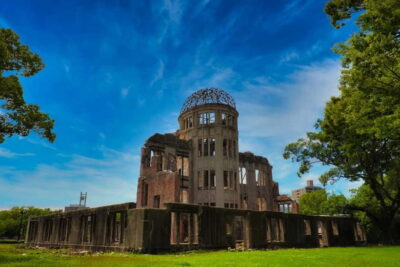
Then comes the iconic Atomic Bomb Dome. Seeing it in daylight is one thing. Seeing it after dark is another. The Dome appears as a glowing reminder against the night sky, and the effect is both visual and psychological. Your attention locks in. Your thoughts slow down.
The guide helps you connect what you’re seeing to the reason it became such a strong symbol. You’ll learn not only that it survived, but why Hiroshima is careful with what it shows and how it explains the meaning of survival. The tour’s structure sets you up so that by the time you reach the Dome, you’re not just taking photos. You’re interpreting.
It’s also worth noting the tour includes specific “peace” moments around the Dome, including time with the peace flame earlier and then the final monument after the Dome. That flow helps you avoid the common problem of leaving with only one big photo and no sense of what came before or after.
Finishing at the Hiroshima Atomic Bomb Hypocenter Monument
The tour ends at the Hiroshima Atomic Bomb Hypocenter Monument. This final stop is where the story becomes precise. A “hypocenter” is a technical word, and memorial sites often use that language to anchor memory in facts, not only feelings.
By the time you reach the end, you’ve already seen the major memorial elements: the Gates of Peace, prayer and remembrance spots, museum context, victim markers including the Korean Atomic Bomb Victims Cenotaph, the Children’s Peace Monument, and then the Atomic Bomb Dome. That route makes the last stop feel like a conclusion that’s still open to reflection.
If you like a tour that gives closure without rushing you out, this ending works well. You leave with a clearer mental timeline of the site and the message. You’re also walking away with a sense that Hiroshima’s peace goal is not abstract. It is built from specific names, specific places, and specific memories.
Price, Pacing, and Why $28 Can Be Good Value Here
The price is $28 per person for a 2-hour small-group night walking tour. On paper, that’s not cheap, but here’s the honest value equation. You’re paying for an expert-led route with guided context, not just access to a park.
At a place like this, you don’t want to wander alone guessing what each marker means. You want someone to connect the dots quickly, without turning it into a lecture that goes on too long. The reviews highlight that the pacing is strong, with the tour managing to hit the most important points in only 2 hours. That is the key to whether the value feels fair.
Also, the small-group cap at 10 participants matters for quality. It reduces the chance of feeling like you’re herded through a memorial. It also makes it easier for the guide to respond when you have a question, which can change how much you take in.
What to Bring, What to Wear, and How to Make It Comfortable
This tour is at night and involves walking. You’ll move between several stops in Hiroshima Peace Memorial Park, mostly outdoors. That means the “comfort details” are part of your experience quality.
Bring an umbrella. Wear comfortable shoes with grip. Dress for the weather because night air can feel cooler than you expect, and you’ll be outside for the full 2 hours.
Also, bring the right mindset. This tour focuses on loss and hope, and it can be emotionally heavy. Going with a calm, respectful pace makes a difference. If you’re tired, you’ll rush the meaning. If you’re ready to slow down, the tour reads like a guided story.
Who This Tour Is Best For, and Who Might Skip It
I think this tour is best for you if you want a short, expert-led way to understand Hiroshima’s Peace Memorial Park in one evening. It’s ideal when you have limited time and you want your sightseeing to have context, not just photos.
It also suits you if you like asking questions. The format is small group, so you’re more likely to get direct answers instead of feeling like you’re waiting your turn.
You might prefer a different approach if you are the kind of visitor who wants to spend a long time inside the museum exhibits on your own. Since the tour includes only a brief museum moment, you’ll likely want separate daytime museum time if you want deep reading.
Should You Book This Hiroshima Night Tour?
If you’re visiting Hiroshima and you want your first impression of Peace Memorial Park to be guided, structured, and meaningful, I’d book this. The highlights, like the Atomic Bomb Dome at night and the variety of memorial stops including the Children’s Peace Monument and the Korean Atomic Bomb Victims Cenotaph, create a route that actually teaches you something.
Also, if you value small-group pacing and you want room for questions, this tour seems built for that. The guides you might meet, including Ghani and Sheraz, are described as engaging and helpful with explanations, and that matters at a site where details count.
My simple decision rule: book it if you want a powerful 2-hour orientation that makes the park’s meaning clearer. Skip or supplement it if you want a longer, self-guided museum session. Either way, plan for walking, bring an umbrella, and give yourself time to absorb what you see.
More Evening Experiences in Hiroshima
- Hiroshima Izakaya Food and Drink Night Tour
★ 5.0 · 297 reviews - Kyoto: Gion Magical Night Walking Tour with Geisha Trivia
★ 4.9 · 2,393 reviews - Night Walk in Gion: Kyoto’s Geisha District
★ 4.5 · 2,003 reviews - Kyoto Night Foodie Tour in Gion (9+ dishes + 6 Sake tastings)
★ 5.0 · 1,762 reviews
More Historical Tours in Hiroshima
- Miyajima Half-day Trip Historical Walking Tour
★ 5.0 · 284 reviews - Hiroshima: History of Hiroshima Group Walking Tour
★ 4.8 · 266 reviews - Hiroshima: Peace Walking Tour of World Heritage Sites
★ 4.9 · 190 reviews - Walking Through History: Hiroshima’s Path to Peace
★ 4.9 · 156 reviews
Fresh options around Hiroshima
- Hiroshima Peace Memorial Park: A Guided Tour★ 4.9 · 16 reviews
- Okunoshima Rabbit Island Cycling Tour with Local Guide★ 4.5 · 17 reviews
- Shore Excursion from Hiroshima Port : Private Tour in Hiroshima★ 5.0 · 17 reviews
- Mitaki Peace Tour Beyond Central Hiroshima★ 5.0 · 18 reviews
- Hiroshima and Miyajima Full Day Private Tour★ 4.5 · 19 reviews
- 4 Hour Miyajima PRIVATE Tour★ 5.0 · 19 reviews
- Hiroshima Private Walking Tour with a Local★ 4.5 · 19 reviews
- Hiroshima Scenic Cycling Guided Tour★ 5.0 · 19 reviews
Historical Tours, compared.
World Heritage Shirakawa-go and Experience Tours from Kanazawa
Read our review →
Imperial Palace and Shogun Historical Walking Tour
Read our review →
World Heritage Kyoto & Nara Uji Authentic Matcha Experience
Read our review →
Kyoto Gion: 2-Hour Geisha Culture & History Walking Tour
Read our review →
World Heritage Shirakawa-go Morning Guided Tour
Read our review →
Hiroshima Historical Walking Tour – Why A-Bomb was Dropped
Read our review →
Hiroshima Peace (Heiwa) Walking Tour at World Heritage Sites
Read our review →Browse the lists this tour appears in