
Reviewed · WORKSHOPS
Kintsugi Workshop in Naha, Okinawa
Cracked pottery does not have to mean goodbye. In this kintsugi workshop, I love how you repair a broken piece using gold or silver style lacquer while learning the Japanese mindset behind making flaws beautiful. I also like that the class is hands-on and take-home, so you leave with a display piece you actually made. The one tradeoff: your finished item is for display only, not for eating or drinking.
This is run as a small group class, limited to 5 people, and the instruction is available in English and Japanese. With patient coaching, you’re not stuck guessing what to do next. If you’re hoping to fully recreate the traditional, long curing process, the workshop is a simplified version, so it is more about learning and creating than about producing a functional heirloom item.
Key Kintsugi Takeaways to Know Before You Go
- Gold or silver style repairs that turn fractures into part of the design
- Simplified process in 2 hours, guided step-by-step so no experience is needed
- Small group size (up to 5) for real attention, not a crowded classroom vibe
- Display-only finished piece, since it can’t be used for food or drink
- Urushi Studio Kodemari brings a calm, studio-focused atmosphere to Naha
- Friendly instructors like Mayo and Aya help you make something you’re proud to take home
Kintsugi in Naha: Turning Breaks Into Design
Kintsugi is one of those arts that sounds fancy, then quickly becomes practical once you see it. The idea is simple: when pottery breaks, you don’t hide the evidence. You repair it, often with a metallic line that makes the join look intentional. In Naha, this workshop gives you the chance to do that yourself, with guidance that keeps the process understandable and surprisingly soothing.
What makes this workshop feel especially right for a trip is the combination of craft plus mindset. You are doing detailed work, but you’re not being rushed. The rhythm is more like careful restoration than like a high-energy souvenir factory. And because you end with a take-home piece, it feels more meaningful than watching a demo and moving on.
You’ll also get a very realistic expectation from the start. This is a shortened, simplified learning experience, not the full traditional timeline. That matters because it keeps the class workable for visitors, while still teaching you the core concept: the repair line becomes the artwork.
A few more Naha days worth comparing
- Official Street Go-Kart Tour – Okinawa Shop
★ 5.0 · 699 reviews - Naha: North Okinawa Sightseeing Tour & Churaumi Aquarium
★ 4.4 · 472 reviews - Okinawa: From Naha: Kerama Islands 1-day snorkeling tour
★ 4.4 · 423 reviews
Where You’ll Do the Workshop: Urushi Studio Kodemari in Okinawa
This experience is hosted by Urushi Studio Kodemari, a studio setting that makes a big difference for a hands-on class. Reviews and guest comments consistently point to a calm space with comfortable seating and air conditioning, which is a real comfort in Okinawa when the weather can be warm.
A studio environment also helps because kintsugi is detail work. You want a place where your hands can move slowly and your eyes can focus on tiny alignment moments. The setup also supports small group learning, so you don’t feel like you’re competing for space or tools.
If you’re traveling with time pressure, this is still a manageable stop. The workshop is 2 hours, and it’s structured enough that you know you’ll finish with something tangible. You just need to plan your day around the class time, since transportation isn’t included.
The 2-Hour Flow: What Happens From Start to Finish
You should think of this class as a guided sequence of steps, rather than one single technique. The studio uses a process you can follow even if you have never done kintsugi before. One guest described it as a multi-step routine, and the point is that you’re not thrown into experimentation.
Here’s what the experience typically feels like inside that 2-hour window:
You start with an explanation of how kintsugi repairs work and what makes the joint line so important. Then you work on your chosen piece. The workshop is designed so you can go from broken ceramic to a finished look without needing prior practice.
Next comes the part that makes kintsugi special: creating the repair using a metallic finish. The class focuses on the visual result and the core method, using gold or silver style repair lines as part of the design language. Throughout, the instructor checks in so you don’t end up with a crooked join or a finish that doesn’t match the style you want.
Finally, you complete the finishing touches and prepare your piece to take home. Since this is simplified kintsugi, you’ll end with a beautiful display item that you can bring into your home right away as a souvenir.
The big takeaway: the workshop is built for visitors who want to learn a traditional Japanese art and leave with proof they did it, not just a certificate.
Choosing Your Piece: Bowls, Plates, and Pendant Options
One of the most practical perks of this class is that you get options for what you work on. People have mentioned choosing a dish, and other guests have noted options like a bowl or even a pendant instead of tableware.
That flexibility matters if you’re thinking about packing. A small plate or pendant is much easier to fit into luggage than a larger ceramic item. It also affects what you’ll do with the finished piece afterward. A bowl or plate can live on a shelf like a small centerpiece. A pendant becomes personal, wearable art.
Here’s how to choose well:
- If you want a home display piece, go for a bowl or plate style item.
- If you want something compact or gift-friendly, ask about pendant or smaller options.
- If you already have something broken, ask in advance how the studio handles customer pieces versus studio-provided items.
Even if the exact choices depend on what is available that day, the studio clearly supports multiple project types. That gives you more control over what your “souvenir” actually becomes.
Same corner of Japan, a different kind of day:
- From Naha: Tokashiki Island Day Trip by Boat
★ 4.3 · 385 reviews - Naha, Okinawa: Keramas Island Snorkeling Day Trip with Lunch
★ 4.7 · 370 reviews - Naha, Okinawa: Kerama Islands Half-Day Whale Watching Tour
★ 4.4 · 241 reviews - Naha, Okinawa: Kerama Islands Full-Day Intro-Diving Trip
★ 4.6 · 203 reviews
How the Metallic Repair Looks: Gold and Silver Style Magic
The signature visual of kintsugi is the metallic repair line. In this workshop, you’re learning a process that uses gold or silver elements to highlight the fracture instead of hiding it.
What I like about this is the way it changes your perception of the object. A repaired crack turns from an accident into a design feature. And because you choose the angle and follow the guidance, the final look reflects both the pottery and your work.
A useful expectation to set: this class produces a simplified repair that is not intended for daily use like a functional dish. The finished work is for interior display. That means you should treat it like art, not like a replacement plate for dinner.
It also means your success criteria is aesthetic. Your goal is a clean, attractive repair line and an overall finish that looks intentional from a short distance, not a lab-perfect bond.
The Mindful Part: Why This Feels Calm, Not Chaotic
Kintsugi sounds like it should be stressful. You’re fixing something broken, you’re working with fine materials, and you’re in a foreign country. Yet the experience has a clear calming vibe.
Guests have described the workshop as therapeutic and calming, with instructors who are kind and patient. That patience shows up in the details. You get clear instructions, and when your hands hesitate or you need an extra adjustment, you get help without judgment.
The mindful feeling comes from the pace. Instead of rushing through a craft for a quick photo, you slow down to do careful work. You also learn that the traditional version is a longer process, and the studio shares context about how long-term curing is part of the traditional approach.
If you’re the kind of traveler who likes quiet experiences during a busy trip, this fits. It’s also a great “brain reset” when you’ve been sightseeing all day and want something calmer that still feels culturally grounded.
Language Support and Instructor Style (English and Japanese)
This workshop includes instruction in English and Japanese, which makes it easier to follow along and ask questions in whichever language feels most comfortable. A small group also helps here, because you’re more likely to get direct attention when you ask about a specific step.
In terms of who you might meet, names like Mayo and Aya show up in guest comments. There are also mentions of a host named Maio and her daughter. Regardless of which instructor greets you, the consistent theme is clear: the teaching style is patient, with practical guidance that keeps you moving forward.
If you’re traveling solo, this matters even more. You can focus on the process without feeling lost, and you still get plenty of interaction.
Price and Value: Why $55 Feels Fair for What You Get
At $55 per person for 2 hours, this workshop is priced like an experience, not like a premium craft service you might book for a custom repair at home. The value comes from what’s included.
You get:
- All materials needed for the workshop
- Expert guidance from the instructor
- A finished piece you can take home as a souvenir
- A culturally rooted technique, not a generic art class
The small group size also improves the value. When you’re limited to 5 participants, you’re more likely to get help at the exact moment you need it. That reduces frustration and boosts your final result.
The only cost-related thing to keep in mind is what you are not getting. Food and drinks are not included, and transportation isn’t included either. In exchange, you get a focused block of craft time that ends with something you can display.
Practical Tips for a Smooth Session in Naha
A workshop like this is pretty straightforward, but a few practical choices can make it easier.
First, plan your schedule. Since it’s 2 hours, give yourself enough time before and after for getting there and settling your plans.
Second, think about packing. A repaired ceramic item is delicate. If you have a place in your luggage for careful wrapping, use it. If you’re buying a pendant-style option, it may be easier to store, but still treat it with care.
Third, manage expectations about usability. This piece is designed for display only, not for eating or drinking. If you want something functional for daily life, kintsugi is not the right tool for that purpose in this format.
Finally, bring curiosity. The best part of cultural craft classes is the context you pick up while working. In this workshop, you learn not only what to do, but why kintsugi values the history of a crack instead of treating it as waste.
Who This Workshop Is Best For
This is a great match for:
- Anyone who wants a hands-on Japanese craft without needing experience
- Travelers who prefer small group activities with real guidance
- People who like mindful, calming experiences during a trip
- Souvenir shoppers who want something authentic, not generic
It’s less ideal if:
- You need a functional dish for eating or drinking
- You want a full traditional kintsugi timeline, with the longer curing process
- You are looking for a high-energy tour with lots of moving around
If you’re doing a few days in Okinawa and you want one day to slow down, this fits beautifully. If you’re coming for cultural depth and a take-home artifact, it’s also a strong choice.
Should You Book the Kintsugi Workshop in Naha?
I think you should book it if you want a calm, meaningful activity that teaches a real Japanese craft and gives you a finished piece to display at home. The $55 price works well because materials and instructor guidance are included, and the class is small enough to feel personal.
Book it especially if you like the idea of repairing something imperfect. Kintsugi turns a break into design, and the workshop makes that concept practical. Just be clear about the limit: this simplified piece is for display, not for use with food or drink.
If that matches what you want in a souvenir and an experience, you’ll leave with something better than a postcard, your hands will have learned a traditional technique, and your trip gets one quietly memorable chapter in Naha.
FAQ
How long is the kintsugi workshop in Naha?
The workshop lasts 2 hours.
What does the workshop cost?
The price is $55 per person.
Do I need any prior experience with kintsugi?
No prior experience is required. The instructor guides you through each step.
What languages are used during the workshop?
The instructor provides guidance in English and Japanese.
How large is the group?
The workshop is a small group limited to 5 participants.
Can the finished piece be used for eating or drinking?
No. The piece you create in this experience is a simplified version and cannot be used for eating or drinking. It is for display as an interior art piece.
What’s included in the price?
All materials needed for the workshop and expert guidance by the instructor are included. Food and drinks are not included.
Fresh options around Naha
- Naha: “Orca” Spotting Glass Bottom Boat & Sam’s Famous Steak★ 3.8 · 12 reviews
- Naha: Journey into Okinawa’s WWII Navy Underground HQ★ 4.6 · 12 reviews
- Walking around town in a kimono, you can choose your favorite kimono from the traditional Okinawan costumes “Ryuso”, “Kimono”, “Yukata” 《Hairset & Lipstick & Kimono & Rental Fee》All Comic Book★ 4.5 · 14 reviews
- Tokashiki Island Day Trip from Naha★ 4.0 · 15 reviews
- Port Pick-Up: Naha Private Tour Licensed Guide& Vehicle★ 4.5 · 16 reviews
- Okinawa:Kerama Islands experience Diving/Snorkeling/WhaleWatching★ 4.5 · 16 reviews
- Traditional Japanese Costumes “Kimono”, “Yukata”, “Ryuso”, “Photograph Course “Hair Set & Lipstick & Kimono & Photography”★ 5.0 · 17 reviews
- Okinawa Full Tour: Castle, Manza, Kouri, Aquarium & American★ 5.0 · 17 reviews
Workshops, compared.
Sushi Making Tokyo Roll and Authentic Japanese Sushi Class
Read our review →
Roll and Authentic Sushi Making Class in Asakusa
Read our review →
Ramen Cooking Class at Ramen Factory in Kyoto
Read our review →
Sushi Making Class in a Happi Coat near a Famous Spot
Read our review →
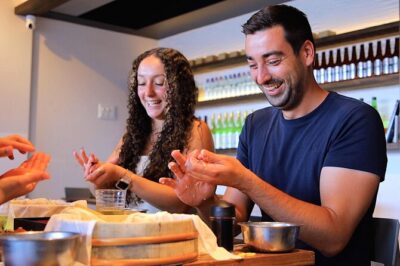
Sushi Making Osaka Roll and Authentic Japanese Sushi Class
Read our review →Browse the lists this tour appears in