
Reviewed · WALKING TOURS
Tokyo: Asakusa Walking Tour with Japanese Comedian
Tokyo’s temple streets make more sense with a guide.
This Asakusa walking tour is built around Senso-ji and the surrounding shrine complex, with a comedian like Karate Comic Ryo keeping the pace light while you learn what you’re actually looking at. I like that it’s small-group, capped low enough that you can ask questions, and I also like that the route is practical, so you get a smooth walk instead of wandering in circles.
One thing to consider: you will do a lot of walking on uneven sidewalks around historic sites, so it helps to wear comfortable shoes and plan for crowds if you don’t start early.
Key things to know before you go
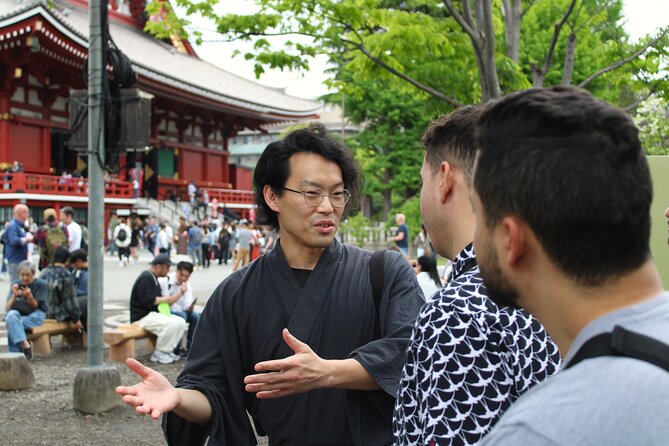
- Comedian-led, history-rich route with Karate Comic Ryo guiding the story of Asakusa
- Small-group pace (listed up to six, and also capped at a maximum of eight)
- Senso-ji plus the nearby shrine gates like Nitenmon and Hozomon, not just the main hall
- Free entry stops across the main sights, so your money goes to the experience, not tickets
- Time to look, take photos, and grab snacks near Nakamise and Nishi-sando
Why Asakusa feels different with a comedian guide
Asakusa can be overwhelming in the best way. You’ve got temples, gates, and side streets packed close together, and it’s easy to walk past the details that make the place meaningful.
Karate Comic Ryo brings a stand-up comedian rhythm to the walk, so the facts land without turning into a lecture. In practice, that means you’re more likely to notice things like statues, gate meanings, and why certain areas feel calmer than others.
More Walking Tours in Tokyo
- Tokyo Tsukiji Fish Market Food and Culture Walking Tour
★ 5.0 · 3,184 reviews - Tokyo: Imperial Palace and Shogun Historical Walking Tour
★ 5.0 · 2,251 reviews - Tokyo: Shinjuku Local Bar and Izakaya Guided Walking Tour
★ 4.9 · 1,794 reviews
Starting at Tokyo Cruise Asakusa Pier, then looking up fast
You meet at Tokyo Cruise Asakusa Pier (1-chōme-1-1 Hanakawado, Taito City). From there, the tour quickly orients you with a payoff view.
The first stop is the Asakusa Culture Tourist Information Center, where you check the view from the 8th floor. That early “look around” moment is a big deal because it helps you map the area in your head before you go deeper into temple streets.
Kaminarimon and Nakamise: the icon gateway plus snack energy
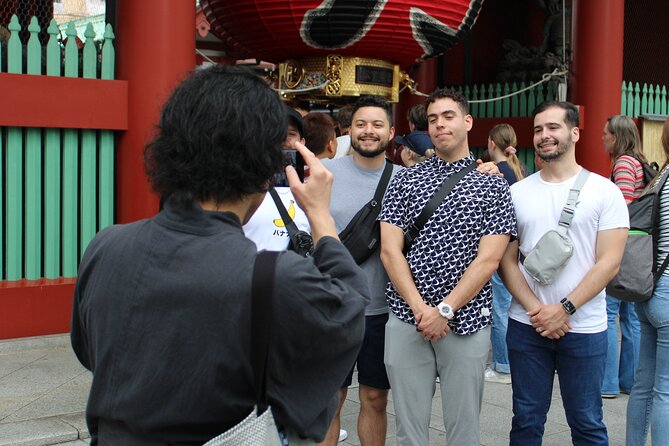
Next comes Nakamise Shopping Street through Kaminarimon, the iconic main gate of Senso-ji. Even if you’ve seen photos, it hits different in person because the gate frames the whole experience.
The route uses this as your easy entry point, so you start walking toward the temple complex without guessing. It also puts you near the shopping rhythm right away, and that matters because Asakusa is not only history, it’s everyday street life.
If you can, consider an early start. One traveler noted starting at 8am kept the area far calmer than later, and it makes a real difference for both comfort and photos.
Bentendo and the Bell of Time: learning the meaning behind small spots
Inside the main Senso-ji area, the tour shifts to some of the sites that often get skipped when you’re just chasing the biggest photo.
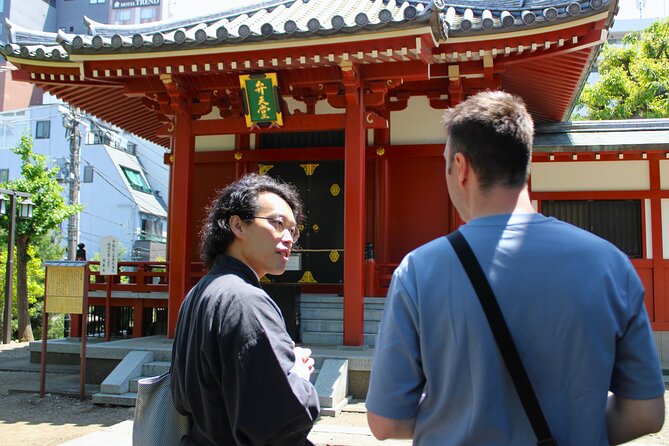
First up is Senso-ji Bentendo, a smaller temple area dedicated to a deity connected to art and prosperity. Then you step next door to the Bell of Time, historically rung by a monk during the Edo period (from the 16th to the 18th century) to mark time.
What I like here is the focus on “why this is here.” Instead of treating every object as decoration, you get a reason for noticing it, which makes your photos feel more like memories than random snapshots.
Same corner of Japan, a different kind of day:
- Mt Fuji and Hakone 1-Day Bus Tour Return by Bullet Train
★ 5.0 · 26,383 reviews - 1-Day Tokyo Bus Tour
★ 5.0 · 14,250 reviews - Tokyo: TOKYO SKYTREE® Admission ticket
★ 4.5 · 11,192 reviews - Tokyo: teamLab Planets TOKYO Digital Art Museum Entry Ticket
★ 4.6 · 9,779 reviews
Nisombutsu and the “look harder” Buddhist statues
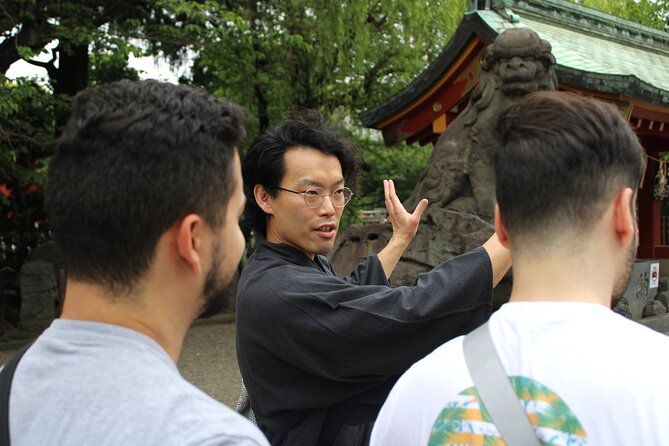
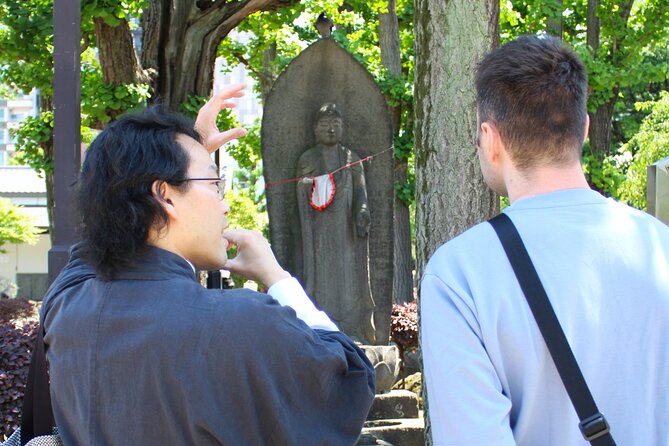
Another calm stop is Senso-ji Nisombutsu, which features multiple Buddhist figures. You’ll see two bronze statues and four stone statues of Buddhist deities built in the 17th century.
This is one of those places where the setting slows you down. If you’re traveling with kids or people who get restless, this short pause can help everyone reset without losing the thread of the tour.
You also learn something practical: when a spot looks quiet compared to the main flow, it often has a different purpose, and the symbols are meant to be seen deliberately.
Nitenmon Gate: where shogun-era power shows up in stone
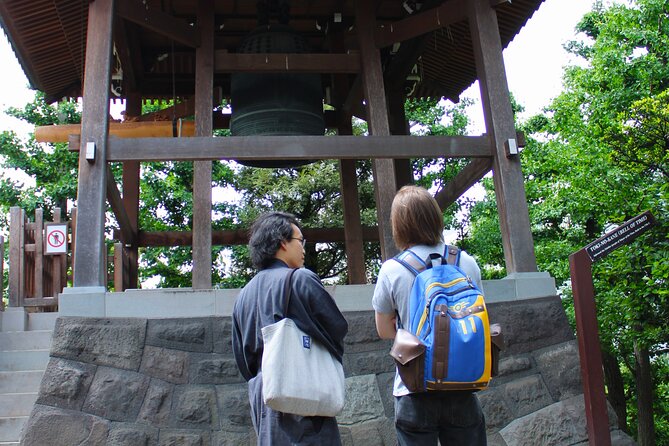
As the walk continues, you reach Senso-ji Nitenmon Gate on the right of the main hall. The guide explains it as a National Cultural Property in Japan, and the key point is its shogun-era role: it was used as the shogun’s gate, meaning only the general was allowed to pass.
That’s a striking detail because it turns the gate from background scenery into history with a clear rule. You start to understand the temple complex not just as a religious site, but also as a space shaped by leadership, access, and ceremony.
Asakusa Shrine: three deities tied to Senso-ji’s origin
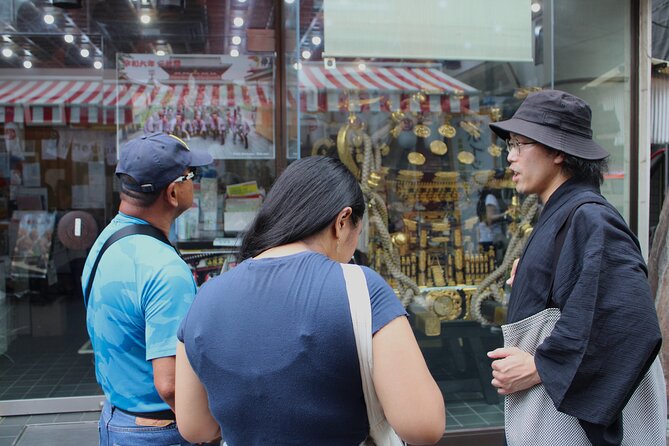
After Nitenmon, you’ll see Asakusa Shrine, described as having three deities related to the origin of Senso-ji. There’s also a garage for three large portable shrines carried by locals during shrine processions.
This stop is valuable because it shows the relationship between the shrine world and the temple world in the same neighborhood. You get a sense that Asakusa is a living religious map, not a museum set.
And if you like photography, shrine processions and storage structures are visual. Even when you’re not attending a festival, you’re seeing the infrastructure that makes festivals possible.
Yogodo and Awashimado: quiet, specific temple corners
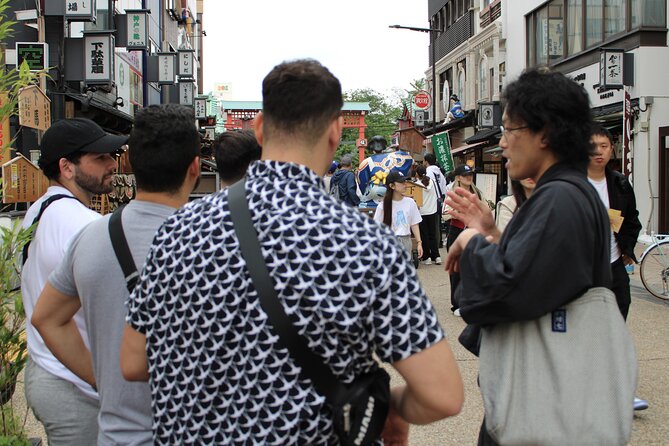
The tour keeps moving through the Senso-ji complex at a steady pace, stopping at Yogodo and Awashimado. These are shorter stops, but they matter because they fill in what’s behind the most famous areas.
The biggest benefit here is balance. A lot of temple tours go straight from big landmark to big landmark. This one mixes in smaller corners, so you feel like you got a broader view of the complex’s layout and tone.
Nishi-sando snacks: melon-bread at Kagetsu-do
Between the temple stops, you get a taste of street food culture through Asakusa Nishisando. If you want a snack, the guide can drop by 花月堂 (Kagetsu-do) for melon-bread.
I like this kind of built-in break because it’s optional but convenient. You don’t have to hunt for something tasty while you’re also trying to keep track of temples and gates.
One traveler even called out that the recommended melon-pan was so sweet they remembered it long after the walk.
Hozomon Gate to the main hall: the final approach
Near the end you hit Hozomon, a gate in front of the temple with a pair of guardian statues. Guardians like these are not random decoration. They’re part of the message of protection and boundary setting, which is exactly what you want to notice as you approach the center.
Then the walk finishes in front of the main hall at Senso-ji, the oldest temple in Tokyo, with about 1,400 years of history. You’ll get the story around Kannon Bodhisattva, which helps the whole route click into place.
When you end at the main hall, you’re not just there to take one final photo. You’ve already seen the gates, statues, and side halls, so the big moment feels earned.
What Karate Comic Ryo adds beyond the sightseeing
The standout feature is how the guide changes the feel of learning.
In multiple comments, people highlighted that Ryo is funny, patient, and answers questions well. That matters because Senso-ji and the surrounding shrine complex can feel technical if you go in with no context, especially with gate names and deity symbolism.
Ryo’s background also comes through. One thread of comments mentioned he has a history connected to rickshaw guiding, which likely explains the smooth way he keeps people moving and oriented.
For you, the practical benefit is confidence. You’ll understand what you’re looking at, and you’ll know where to stand, where to look up, and what to ask so the experience doesn’t turn into frantic photo-taking.
Value check: $37.99 for a tight route with free sights
At $37.99 per person, this tour is priced low for what you get in a major city.
Here’s why the value feels real. Many of the key stops are listed with free admission, meaning you’re paying mostly for the guidance, route planning, and interpretation. Add in a walk time of about 1 hour 30 minutes, and you get a focused introduction without burning your whole morning.
The small group limit also affects value. With a smaller group, you spend less time waiting and more time stopping for details. For a first visit to Asakusa, that alone can save you time and confusion.
If you enjoy city walks with stories, this is a smart “first week in Tokyo” kind of activity. It helps you later when you wander on your own, because the landmarks stop being names and start being places you recognize.
Timing tips that actually matter in Asakusa
Asakusa has crowds, especially closer to the temple flow. The tour experience is easiest when you reduce friction early.
If you can, aim for an earlier slot. One traveler noted that starting at 8am meant calmer streets, while crowd levels ramped up by 9am. Even if you cannot go that early, the general advice holds: you’ll enjoy the gates, statues, and quieter corners more when you’re not fighting foot traffic.
Also, plan for the fact that the walk covers multiple stops within the Senso-ji area plus shopping streets. Bring water, and wear shoes you can trust.
Who should book this Asakusa tour
This is a strong fit if you want:
- an Asakusa walking tour that makes Senso-ji easier to understand
- a comedian guide who keeps things fun while you learn
- a structured route that helps you avoid getting lost in the temple complex and shopping lanes
- a short time window, about 90 minutes, that doesn’t feel rushed
It may be less ideal if you want a fully silent, self-paced experience. And if you dislike walking between religious sites and gates, you might prefer a slower plan on your own.
Should you book Karate Comic Ryo’s Asakusa walking tour?
If you’re heading to Asakusa for the first time, I think this is an easy yes. The combination of Senso-ji landmarks, the nearby shrine stops, and a guide who mixes humor with clear explanations turns the whole area into something you can actually follow.
Book it especially if you like asking questions and if you want your photos to come with context. The price is modest for Tokyo, and the route focuses on places you could miss if you only skim the main thoroughfares.
FAQ
How long is the Asakusa walking tour?
The tour is listed at about 1 hour 30 minutes.
How many people are in the group?
It is described as a small-group experience capped at six people, and the activity maximum is listed as eight travelers.
Where do I meet, and where does the tour end?
You meet at Tokyo Cruise Asakusa Pier (1-chōme-1-1 Hanakawado, Taito City). The tour finishes in front of the main hall of Sensō-ji Temple (2-chōme-3-1 Asakusa, Taito City).
What sites will you see during the walk?
You’ll visit key Asakusa and Senso-ji area landmarks including Asakusa Culture Tourist Information Center, Nakamise Shopping Street through Kaminarimon, and multiple stops inside the Senso-ji complex plus nearby shrine gates, ending at the main hall of Senso-ji.
Are there admission fees for the stops?
The stops listed for the tour are marked with free admission.
Is the guide a comedian?
Yes. The tour is led by Karate Comic Ryo, described as a stand-up comedian guide.
Is the meeting point near public transportation?
Yes, it is listed as near public transportation.
Can I bring a service animal?
Yes, service animals are allowed.
What is the cancellation window for a full refund?
You can cancel up to 24 hours in advance for a full refund. Canceling within 24 hours does not include a refund.
Fresh options around Tokyo
- Tokyo: Nikko Kegon Falls Lake Chuzenji Toshogu Temple & More★ 4.9 · 12 reviews
- Tokyo: Samurai History Walking Tour★ 5.0 · 12 reviews
- Harajuku: Kawaii Fashion and Pop-Culture Tour★ 4.7 · 12 reviews
- Tokyo: Mt. Fuji & Lake Kawaguchi Instagram Full Day Trip★ 4.1 · 12 reviews
- Shibuya Tokyo: Modern Kintsugi Workshop in Shibuya★ 5.0 · 12 reviews
- Tokyo: GTR Guided Daikoku Experience at Night★ 5.0 · 12 reviews
- Tokyo: Daikoku JDM Car Culture Tour★ 4.6 · 12 reviews
- Mt Fuji Private Day Trip from Tokyo with English speaking driver★ 5.0 · 13 reviews
Walking Tours, compared.
Kyoto Geisha Walking Tour: Gion District & Hidden Gems
Read our review →
Tokyo Tsukiji Fish Market Food and Culture Walking Tour
Read our review →
Gion Magical Night Walking Tour with Geisha Trivia
Read our review →
Imperial Palace and Shogun Historical Walking Tour
Read our review →
Gion Geisha District Walking Tour – Stories of Geisha
Read our review →
Shinjuku Local Bar and Izakaya Guided Walking Tour
Read our review →
Browse the lists this tour appears in