Reviewed · KYOTO TOURS
Authentic knife making experience at a blacksmith in Kyoto
You turn glowing steel into a knife. In Kyoto, this is real blacksmithing work, not a museum show, and it ends with a handmade Japanese kitchen knife you can use at home. You’ll get English and Japanese guidance from instructors like Mao, a professional with 10+ years in the craft, and you’ll do most of the work yourself in a small-group setting.
I especially like that the result is practical, about 13 to 15 cm, and packaged for travel with a box and bag. I also like the teaching style, clear tool guidance and patient coaching while you hammer and shape, so even first-timers can finish with something you are actually proud to gift. One thing to consider: this class is physically demanding and involves hot metal, around 800 to 900°C, so stretch first and take the safety rules seriously.
Key Points You’ll Feel Right Away
- A usable souvenir, not a decorative trinket, with a blade size designed for everyday kitchen use
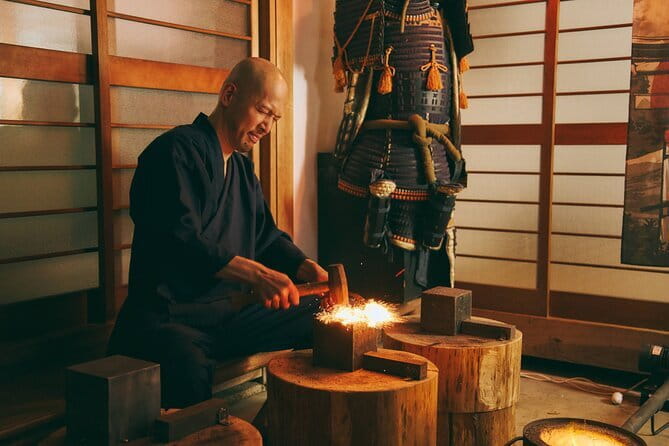
- Hands-on forging from red-hot steel, with coaching on hammer angle and rhythm
- Traditional attire and a real workshop pace, including photos and videos during key moments
- Sharpening and finishing included, using stones and grinders so your edge has a proper start
- Curveball worth knowing, some sessions offer handle/no-handle options, and handle can cost extra (5,000 yen)
- A heat-heavy activity done safely, with instructors emphasizing correct handling and protective habits
Knife Making In Kyoto, Not Just Watching Heat
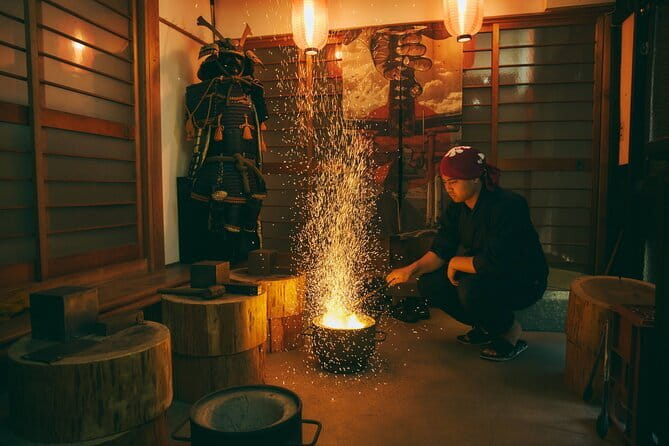
Kyoto gets a lot of credit for tea, temples, and careful preservation. This is different. You’ll work in the middle of a blacksmith shop, where heat, metal, and muscle do the talking. And because you’re actually forging, the experience lands in your body, not just in your camera roll.
The best part is that this workshop is built around a simple idea: you should leave with a knife you can keep using. The final blade is about 13 to 15 cm, fully handmade, and packed to travel home. That turns the class from a one-day story into a tool you pull out months later.
You also get a rare craft. Blacksmithing in Japan is not something you casually stumble into while sightseeing. Here, you get guided practice in the techniques behind Japanese kitchen knives, taught in a way that makes sense even if you’ve never held a hammer before.
A few more Kyoto days worth comparing
- PERFECT KYOTO 1-Day Bus Tour
★ 5.0 · 13,518 reviews - Kyoto: Fushimi Inari, Kinkakuji, Bamboo Grove 1 Day Bus Tour
★ 4.8 · 4,316 reviews - Kyoto: Tea Ceremony in a Traditional Tea House in Kiyomizu
★ 4.9 · 3,519 reviews
Price And What You Actually Get For $154
At $154 per person for roughly 3 hours, you’re paying for two things that matter: instruction and materials. This is not the kind of experience where you only “try” a few motions and then watch the rest. You’ll go through the full chain, from heating steel to shaping and then sharpening and polishing.
The included items do add real value:
- Costume (traditional attire)
- Towel and water
- Tools and materials
- Box and bag for the finished knife
That packaging part sounds small until you’ve paid for fragile souvenirs in the past. Here, your knife is meant to be taken home, stored, and used.
Also, the workshop is a refined 2.5-hour format for knife making, with a 3-hour overall duration. That balance is nice if you want a hands-on day without losing your whole afternoon.
Getting To Studio Shinobi Yase, Plus The Two-Site Setup
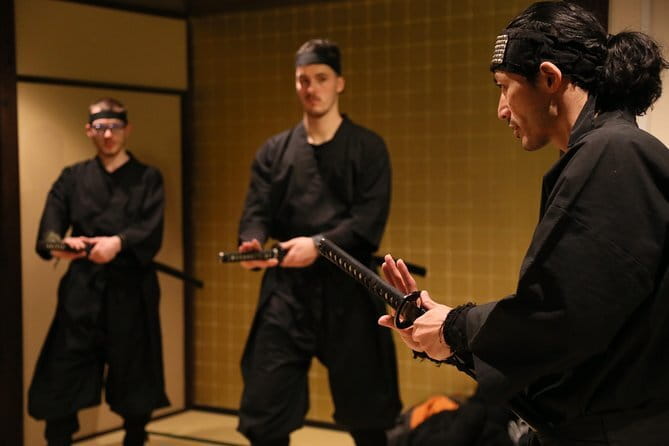
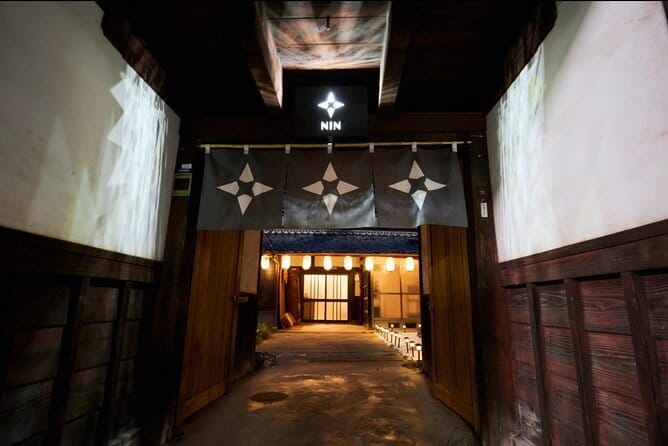
Your meeting point is Studio Shinobi YASE, 168-1 Yase-no-secho, Sakyo-ku, Kyoto City. It’s a one-minute walk from the Yase-Hieizan Exit of the Eizan Electric Railway, so train access is the easiest plan.
One practical thing: the workshop operates out of two studios in Sakyo-ku, Kyoto. You’ll get a message from staff prior to your visit confirming which studio you should attend, either Studio NIN Yase or Studio NIN Kendo. So, don’t rely only on one address screenshot from your booking screen. Check the message the day before.
If you’re the type who hates last-minute confusion, do this: take a screenshot of the confirmed studio name and address, and pin it in your maps app. This small step saves you the stress of guessing where staff want you to go.
The 3-Hour Flow: From Check-In To A Finished Blade
This workshop runs like a clean, time-ordered sequence. Here’s what you can expect, in the order you’ll experience it.
Same corner of Japan, a different kind of day:
- Kyoto Geisha Walking Tour: Gion District & Hidden Gems
★ 4.7 · 3,273 reviews - Kyoto: Tea Ceremony Ju-An at Jotokuji Temple
★ 4.9 · 3,207 reviews - Kyoto: Gion Magical Night Walking Tour with Geisha Trivia
★ 4.9 · 2,393 reviews - Kyoto: 45-Minute Tea Ceremony Lesson Experience
★ 4.3 · 2,378 reviews
1) Check-in and a welcome from the lead instructor
You arrive at the studio and meet your instructor. In this program, Mao is listed as the knife professional, with over 10 years of experience. In practice, the teaching team can include multiple staff members, with some classes noted as including instructors named Mits and Atsushi alongside Mao.
You’ll also get the overall safety and “what happens next” overview so you know what you’re walking into.
2) Traditional blacksmith attire, right away
Next you change into traditional blacksmith attire, the craftsman’s uniform Japanese smiths wear. It’s not just for photos. The point is psychological, it sets the mindset that this is serious work, not a casual craft demo.
3) Tools and safety rules, before you touch hot metal
Before any hammering, you learn how to handle the key tools, like hammers, tongs, and grinders. You’ll get safety explanations that are specific to what you’ll do during the session.
This matters because the activity includes dangerous work in normal forging conditions. Even if the staff are careful, you need to follow their instructions.
4) Understanding the forging process for Japanese kitchen knives
Mao walks you through the traditional techniques used to craft Japanese kitchen knives and how each step changes raw steel into a blade. You’re not just memorizing steps. You understand why you heat, shape, cool, refine, and sharpen.
This is also where the experience feels more authentic than a simple souvenir workshop. You get craft context, not just motion training.
5) Heating the steel until it glows red-hot
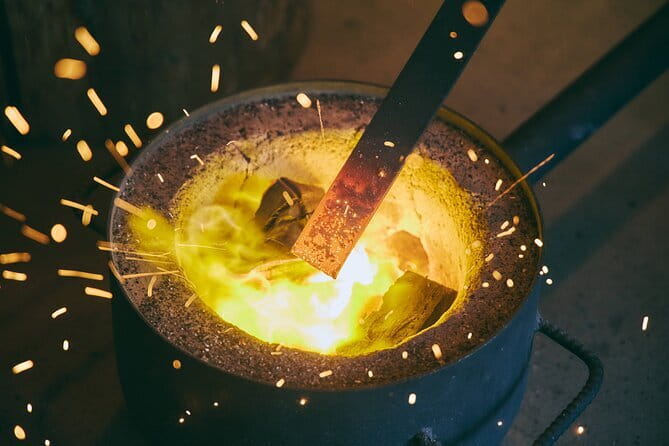
Then comes the furnace moment. Raw iron goes into the heat and warms until it glows red-hot. It’s dramatic, but it’s also the heart of forging. You’ll see how heat changes the metal’s behavior and why timing matters.
6) The highlight: forging the blade with guided hammering
This is the part most people remember. You’ll strike the glowing steel repeatedly with a hammer while Mao guides you closely.
They teach you hammering angle, rhythm, and precision, so you’re not guessing. At the same time, you’re staying safe and working within the staff’s coaching.
If you want a sign of whether this experience is worth it, look at the emphasis on correct hammer technique. A knife is shaped by many small corrections, and the instructors make sure your hammering translates into the blade form you’ll actually take home.
7) Cooling and refining the blade shape
Once the shaping is done, the metal is cooled and checked. You’ll refine rough edges and get the blade ready for sharpening.
This step is where patience pays off. The work shifts from “force” to “finish,” and that’s a good change of pace.
8) Sharpening the knife, even as a beginner
Under expert instruction, you’ll sharpen using stones and grinders. Even beginners can shape a functional edge with guidance.
This is a key value point. A lot of souvenir workshops skip sharpening and leave you with something that looks like a knife but does not really behave like one. Here, you work the edge so your knife has a usable start.
9) Polishing and final finish
You’ll polish the blade to a clean finish. This final step transforms forged steel into a knife that looks handmade in the best way: human effort, visible craft, and a finish that feels intentional.
Some sessions are described as ending with Kurouchi finish, a rustic, rawly forged look that helps with anti-rust characteristics. If your goal is polished chrome shine, that might surprise you. In that case, ask what finish you are expected to bring home so your expectations match the craft aesthetic.
10) Photos, videos, and taking your knife home
Photos and videos are welcome throughout the process. You’ll take home your finished knife, about 13 to 15 cm long, ready for the box and bag included in the workshop.
11) Closing questions and knife care basics
At the end, you can ask final questions about techniques, history, or knife care. Mao is listed as happy to share professional knowledge, which is great if you want to take better care of the edge after you fly home.
What About Safety, Heat, And Physical Effort
This workshop includes real danger potential, even with careful staffing. The good news is that the instruction is structured around safety. You learn tool handling and safety guidance before any hot work.
Still, you should know what you’re signing up for:
- You work near very high heat (about 800 to 900°C hot metal has been described)
- You hammer and hold metal, so it is physically demanding
- Injuries are unlikely, but the customer is responsible in the unlikely event of an accident
So I tell you to treat it like an active class, not a calm craft. Stretch before you go. Wear socks as requested. And follow the safety callouts exactly when staff correct your stance or tool positioning.
One practical tip from how the class is described: the heat is managed with studio comforts like air conditioning, and there are notes about frozen neck coolers in some sessions. That said, it is still hot work. Hydrate and take breaks when you’re offered or when you feel overheated.
The Knife You Make: Size, Options, And Everyday Use
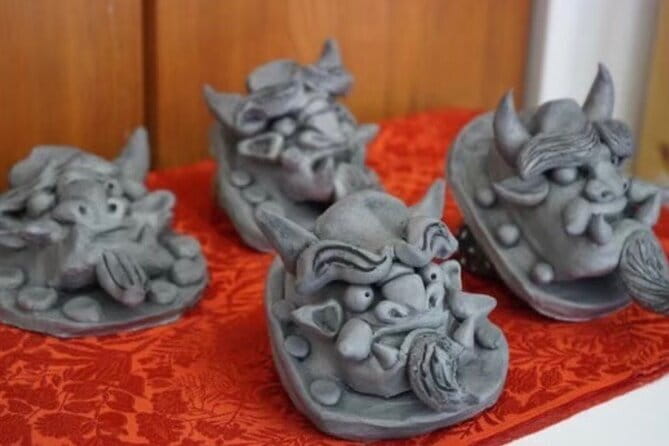
The knife you take home is designed to be practical. The blade length is about 13 to 15 cm, which fits typical kitchen prep. It’s also the kind of souvenir that becomes a daily tool, not a shelf item.
You can also think about gift value. Many people book this for birthdays and family trips because it is personal. You made the thing. The box and bag make it feel like a real purchase, not a DIY project you half-finished.
One detail to understand: some people report choosing whether they make a knife with or without a handle. Handles can cost extra, cited as 5,000 yen in one note. Since you might see this option depending on session setup, ask your instructor when you arrive so there are no surprises.
If you get a Kurouchi finish, remember what that means. The look is intentionally rustic, and it can offer anti-rust benefits. So if you imagine your knife turning into a mirror shine, that’s not the goal here. The charm is the forged surface.
Who This Workshop Is Best For
This is a strong fit if you like hands-on travel. If you prefer workshops over museums, this will click fast. It also suits people who want an “authentic Japan” experience that is not limited to shopping or photos.
It’s also a good family option for the right ages, because the class is structured and guided. But it is not open to everyone. Children under 15 must be accompanied by a guardian, and people over 95 are not suitable.
If you are traveling solo, this can work well too. It’s small group, and the instruction is interactive, so you are not left sitting around waiting your turn.
If you have limited tolerance for physical effort, consider your limits. Hammering is part of the deal. It’s not just a lecture.
Should You Book This Kyoto Knife Making Class
Book it if you want a souvenir with real function. For $154, you get a full process: forging steps, sharpening, and polishing, plus a knife you can keep using. The fact that it is taught by instructors like Mao, in English and Japanese, with small-group coaching, makes it feel accessible without turning it into a watered-down demo.
Skip or rethink it if you dislike hot, physical work. This class is active and warm, and it involves handling tools near high heat. If that sounds stressful, plan for a gentler activity instead.
Also, do your homework on the studio location. Because there are two studios in Sakyo-ku and staff message you the confirmed one, double check the studio name you are instructed to attend. Arrive by train for the smoothest timing, since the meeting point is right by the Eizan Electric Railway exit.
If you want, tell me your travel dates and whether you’re aiming for a particular knife look (with handle, no handle, shinier finish, Kurouchi). I can help you plan the day so this workshop fits cleanly into your Kyoto schedule.
FAQ
How long is the knife making experience?
The duration is 3 hours, including the full workflow from check-in through forging, sharpening, polishing, and taking home your finished knife.
How much does it cost?
It costs $154 per person.
What will I be able to take home?
You’ll take home the knife you make. The finished blade is about 13 to 15 cm long and fully handmade, and it includes a box and bag.
What is included in the price?
Included are costume, towel, water, tools, materials, box, and bag.
What should I bring?
You should bring socks.
Is alcohol allowed during the workshop?
Alcohol and drugs are not allowed.
What languages are used during the class?
Instruction is available in English and Japanese.
Is this workshop suitable for children?
Children under 15 must be accompanied by a guardian. People over 95 are not suitable.
Fresh options around Kyoto
- A Privately Guided Photoshoot in Beautiful Kyoto by a Pro★ 5.0 · 18 reviews
- Kyoto: Fushimi Inari Taisha Shrine Walking Tour with Guide★ 4.8 · 18 reviews
- Sekka Cotton Furoshiki Class★ 5.0 · 19 reviews
- Natural Indigo Dyeing with Local Masters (Private Atelier)★ 5.0 · 19 reviews
- Kyoto: Personalized Guided Private Tour★ 4.8 · 19 reviews
- Kyoto: Quiet and Graceful Tea Ceremony★ 4.5 · 19 reviews
- Oboro | Mindful Tea Ceremony in a 100-Year-Old Kyoto Teahouse★ 5.0 · 19 reviews
- Ikebana Traditional Japanese Art of Flower Arranging★ 4.5 · 19 reviews
Kyoto Tours, compared.


Fushimi Inari, Kinkakuji, Bamboo Grove 1 Day Bus Tour
Read our review →
Tea Ceremony in a Traditional Tea House in Kiyomizu
Read our review →
Kyoto Geisha Walking Tour: Gion District & Hidden Gems
Read our review →

Gion Magical Night Walking Tour with Geisha Trivia
Read our review →