
Reviewed · SAMURAI & NINJA EXPERIENCES
Knife Making Experience in Samurai Sword Town
Seki turns metalwork into a hands-on lesson. You craft your own Damascus knife in the sword town of Seki, Gifu, guided by instructors including Sumio, Yoshi, and Hiro, then finish with a sharpness test on fresh vegetables. I love the practical, step-by-step workshop flow, and I love the small-group attention that lets you actually ask questions instead of rushing through.
One possible drawback to plan for: this is a kitchen-knife experience, not full samurai sword forging. So if you are specifically hoping to build a katana from scratch, your expectations will need a tweak.
Key highlights I’d mark in your planner
- Small-group instruction so you get close help while you sharpen, polish, and engrave
- Damascus-style kitchen knife you assemble yourself, then test on real vegetables
- Hands-on polishing and engraving which makes the craft feel tangible, not just museum watching
- Sword-and-cutlery stop sequence from knife history to modern cutlery production
- Take-home bonus items including a signed completion certificate and a limited mini knife souvenir
- Efficient 5-hour day plan with a private group and a 10:30 start near public transport
Knife town Seki: what you are really doing for 5 hours
This is the kind of Seki experience that makes you slow down and look at how tools are made. You are not just watching. You are making your own Damascus kitchen knife, with a guide who has been doing this craft for decades. The whole day is built around turning that history talk into something you can hold, inspect, and use.
The workshop portion focuses on the practical skills that actually matter for a working blade. You polish and sharpen, engrave, and assemble. Then you get to see the result right away by testing sharpness on fresh vegetables. That last part is important. It turns the day from an arts-and-crafts souvenir into a real maker experience.
The museums and temple stops keep the day grounded in place. Seki is tied to sword-making for centuries, but it is also tied to cutlery production, which is a different kind of craft skill. The combination helps you connect the romance of samurai swords with the everyday reality of knives.
More samurai and ninja experiences in Takayama:
- Ninja Experience in Takayama – Basic Course
★ 5.0 · 62 reviews - Seki: Samurai Knife Making Experience at the Knife Museum
★ 5.0 · 61 reviews - Ninja Experience in Takayama – Basic Course
★ 4.6 · 59 reviews
Start time, meeting point, and how the day runs
The tour starts at 10:30 am at Sekitomioka Station in Hidase, Seki, Gifu 501-3911, Japan. It ends back at the same meeting point, which makes the plan easy if you are doing a day trip.
It is also designed to be workable for visitors. Pickup is offered, the tour uses a mobile ticket, and it is near public transportation. That matters in Japan, because the difference between a smooth day and a stressful one is often just one missed connection.
The experience is private, meaning only your group participates. In practice, that usually supports the standout thing people love about this tour: close instruction. When you are learning a manual process like knife polishing and engraving, being able to focus on your own steps without a crowd in your way makes a big difference.
The full schedule runs about 5 hours. The stop times fit neatly: Knife Museum (about 2 hours), Seki Swordsmith Museum (about 1 hour), Gifu Cutlery Hall (about 30 minutes), and Seki Zenko-ji Temple (about 1.5 hours).
Knife Museum stop: rare blades, and why it helps your build
Your day begins at the Knife Museum in Seki. This stop is longer than the others, about 2 hours, and that tells you what the organizers want you to do first: get your eye trained.
You can see different kinds of knives, including rare and unique examples from around the world. Even if you are not a hardcore knife person, this is the moment where you start comparing styles and purposes. You begin to notice that a knife is not just metal and sharpness. Shape, finish, and craftsmanship choices all matter.
There is a second benefit that is easy to overlook. Looking at knives before you make yours helps you engrave with intention later. When you have a few real references in your head, your own choices can feel more deliberate instead of random.
A practical consideration: if you prefer hands-on learning right away, the museum start might feel like “warm-up time.” It is still part of the value, but it is good to know you will spend a chunk of the morning looking before polishing begins.
Seki Swordsmith Museum: samurai context you can connect to the blade
Next is the Seki Swordsmith Museum, about 1 hour, where you learn about samurai and Japanese sword history. The key detail here is place-based context: Seki City developed as a sword-making center as early as the 13th century.
That time frame does more than add trivia. It explains why the region has the technical knowledge to keep turning out edged tools, even as designs evolved. You start to understand that craftsmanship survives through people, methods, and practice, not just through stories.
This stop also makes the workshop feel less random. When you see the cultural and historical framing first, the workshop tasks, like polishing and engraving, feel like part of a continuity. You are not learning a single isolated hobby project. You are learning a craft step that connects back to the same regional tradition.
If you are short on time in Japan, this is one of the stronger ways to justify a day trip to Seki. It gives you the “why” behind the “how.”
A few more Takayama days worth comparing
- Kanazawa: World Heritage Shirakawa-go Morning Guided Tour
★ 4.9 · 988 reviews - Kanazawa: World Heritage Shirakawa-go & Two Local Experience
★ 4.9 · 274 reviews - Kanazawa/Takayama: Shirakawago & Takayama Private Day Tour
★ 4.8 · 172 reviews - Departing from Takayama [Regular sightseeing bus] World Heritage Sites Shirakawago and Gokayama Ainokura
★ 4.5 · 137 reviews
Gifu Cutlery Hall and Seki Zenko-ji: tools plus a bell moment
After the sword museum, the schedule shifts from history to production. Gifu Cutlery Hall is about 30 minutes and has free admission. It focuses on Seki’s cutlery industry, including the fact that Seki is one of the three cutlery-producing regions in the world, with the highest cutlery production volume in Japan.
This is a useful counterbalance to the samurai story. Swords are ceremonial and symbolic, but cutlery production is also technical, practical, and repeatable. You start to see that the same regional skill set supports both worlds.
Then you head to Seki Zenko-ji Temple for about 1.5 hours. The temple foundation dates back to the mid-eighteenth century, and it is known for features like the Great Bell and a Kaidan tour. You can also try ringing the bell, which is the kind of hands-on moment that breaks up a craft-heavy day.
The drawback here is simple. If you want only knife making and zero cultural stops, the temple time will feel like filler. But if you like rounding out a day so it feels like you left the workshop with a sense of place, this stop does the job.
Making your Damascus kitchen knife: the part you will remember
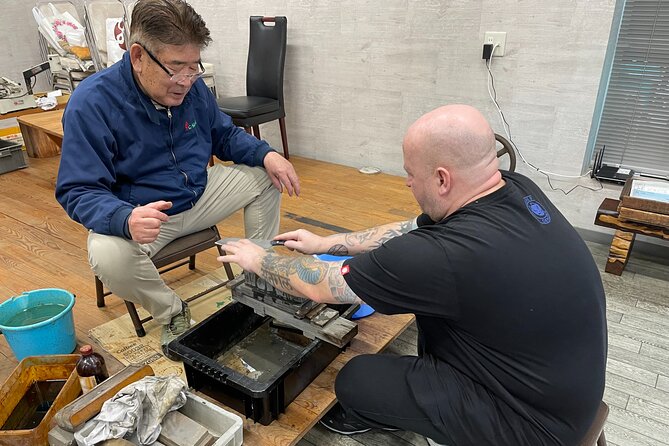
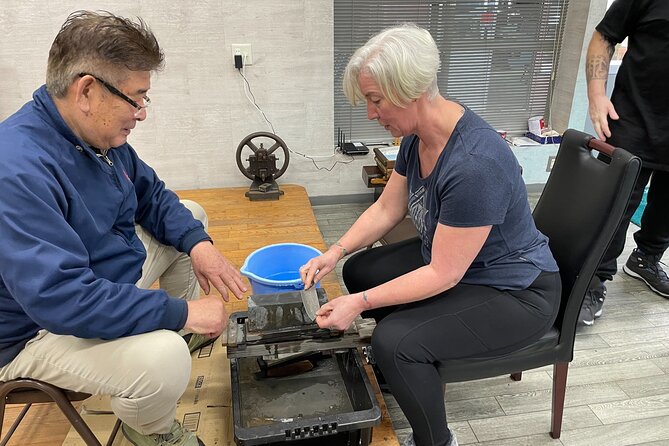
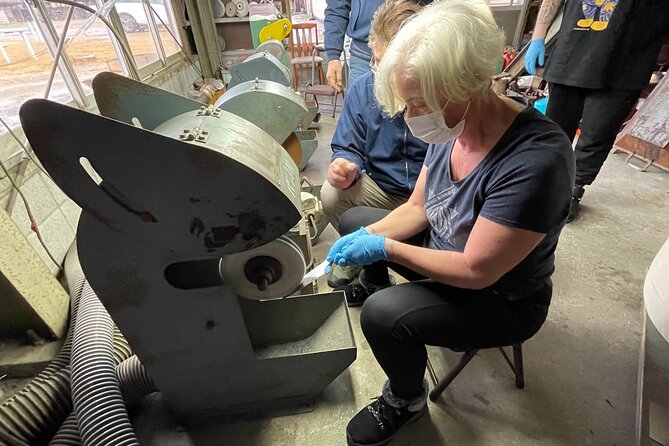
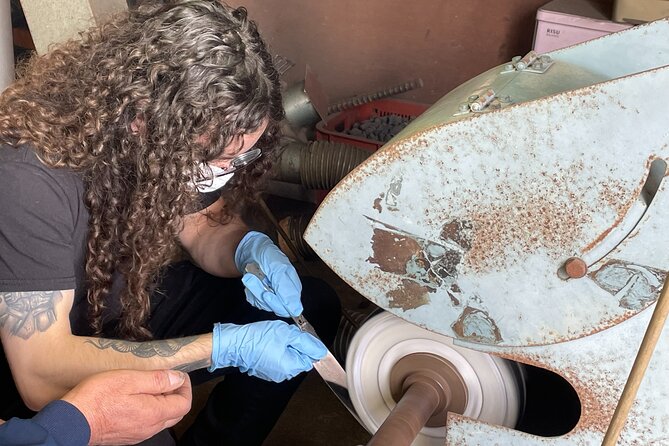
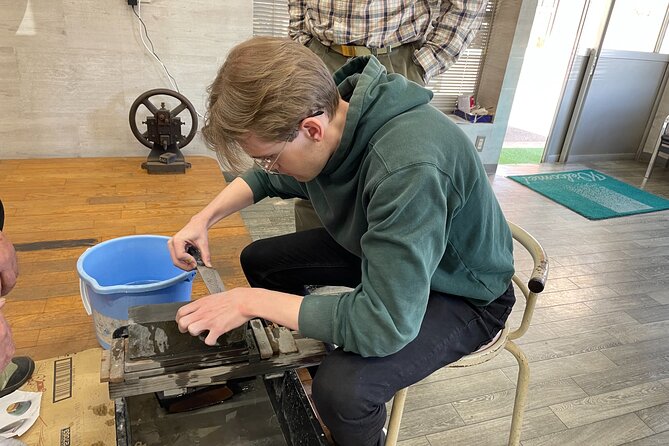
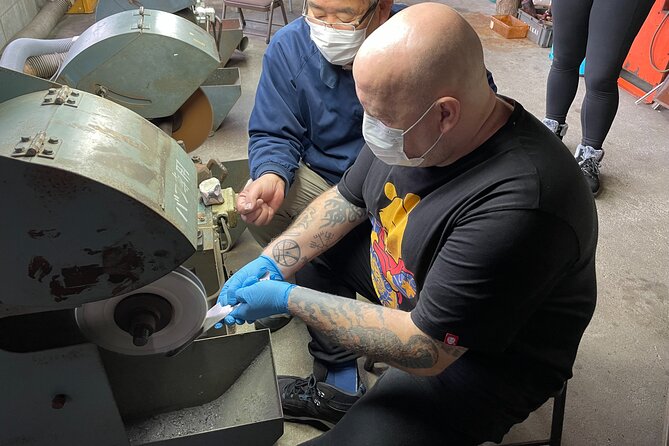
The heart of the experience is the knife-making workshop. You are guided by a master bladesmith with experience over 50 years. The format is hands-on: you work on polishing, sharpening, engraving, and assembly.
This is where the small group really pays off. Reviews highlight that the instruction stays personal, with the makers keeping a tight focus on you. The Sakai brothers are described as passionate about the process, and the teaching style includes clarity and a sense of humor. That combo matters when you are working with fine details like engraving and finishing.
Here is what the experience is set up to do for you:
First, it teaches the craft steps in an order that makes sense. Polishing and sharpening are not random actions. They shape how the blade looks and how it performs.
Second, it gives you a result you can judge immediately. After assembly and finishing, you test sharpness on fresh vegetables. That is the most honest feedback loop you can get. It also makes the day feel satisfying, because you finish with proof, not just a certificate.
Third, it gives you personalization. Engraving is a big part of the emotional payoff. You are building ownership into the knife, not just commissioning a souvenir.
Take-home items are built in. You receive a signed certificate of completion, and there is also a handcrafted mini knife souvenir as a limited-time bonus. Limited availability is part of the deal, so if you hope to maximize the bonus, it is worth keeping expectations realistic.
Price and value at about $316.27 per person
At $316.27 per person, this is not a bargain workshop. But it does bundle several costs into one day, and that changes the value equation.
You are paying for:
- A guided, hands-on Damascus kitchen knife workshop with polishing, sharpening, engraving, and assembly
- A sharpness test with vegetables, which turns the craft into a performance result
- Admission tickets for the Knife Museum and the Seki Swordsmith Museum
- A Japanese lunch
- A signed completion certificate
- A limited mini knife souvenir bonus
If you have ever priced made-by-hand edged tools, you know the material and labor side adds up quickly. You are not only buying a finished object. You are buying instruction, a structured process, and a chance to walk out with a knife you made with your own hands.
This matters most for you if:
- You want a real workshop, not a short demo
- You like craftsmanship and want to understand what goes into a blade finish
- You are okay paying extra for personal attention in a private setting
Where you might pause is if you only want a quick photo stop in the sword town. In that case, the price will feel high for the amount of time you spend actually watching. But the workshop focus here is the point.
Who this fits best, and when to choose another plan
This experience fits best if you are the kind of traveler who likes to learn skills, not just collect stories. If you enjoy tools, blades, engraving, or the design details of kitchen knives, you will likely have a great day.
It also works well if you want a private activity in a small time window. A full day trip from places like Kyoto is roughly 1.5 to 2 hours by train, and the schedule is built to use that time efficiently.
You might consider passing or adjusting expectations if you want:
- A full sword-forging storyline, like building a katana start to finish
- A purely museum-only day
- A very low-cost activity
One more fit note from the reviews: many people loved the small-group format because it kept attention on the process. If you are traveling with friends and you want everyone to get hands-on time, the private setup supports that.
Should you book this Seki knife-making experience?
I would book it if you want a memorable combination of craft and context, with a blade you actually make and test. The day is built around three things: real hands-on steps, a clear cultural setting in Seki, and a satisfying finish where you see sharpness in action.
If you are only curious about samurai swords in theory, or you are expecting katana-scale forging, you might feel slightly mismatched. But for a Damascus-style kitchen knife workshop in a real sword town, with museums and a temple stop as supporting acts, this is a strong value for your time.
If you can swing the price and you like the idea of sharpening and engraving your own knife, this is the kind of day that sticks.
FAQ
How long is the knife making experience?
It lasts about 5 hours (approx.).
Where does the tour start, and what time does it begin?
You meet at Sekitomioka Station in Hidase, Seki, Gifu 501-3911, Japan, and the start time is 10:30 am. The tour ends back at the meeting point.
Is pickup available, and do you use a mobile ticket?
Pickup is offered, and you’ll use a mobile ticket.
What knife will I make during the workshop?
You make your own Damascus kitchen knife, including polishing, sharpening, engraving, and assembly. You also test the sharpness on fresh vegetables.
Are admissions and lunch included?
Admission tickets are included for the Knife Museum and the Seki Swordsmith Museum. Gifu Cutlery Hall and Seki Zenko-ji Temple have free admission, and lunch is included.
Is this a private tour or shared group activity?
This is a private tour/activity, and only your group participates.
Can I cancel for a full refund?
Yes. You can cancel for a full refund up to 24 hours in advance of the experience start time. If you cancel less than 24 hours before the start time, the amount paid is not refunded.
Fresh options around Takayama
- Sawanobori River Trekking Tour★ 5.0 · 30 reviews
- Takayama Private Custom Tour with Local Guide★ 5.0 · 31 reviews
- Takayama: Takayama Jinya & Old Town Private Walking Tour★ 4.5 · 32 reviews
- Explore Kiso Valley : Magome – Tsumago Mountain Trail Walk★ 5.0 · 33 reviews
- Magome & Tsumago Nakasendo Trail Day Hike with Government-Licensed Guide★ 5.0 · 38 reviews
- Japanese Cooking Class with Local Family in Takayama Old Town★ 5.0 · 40 reviews
- Shuriken Experience in Takayama★ 5.0 · 46 reviews
- Hida Takayama, Shirakawa-go+Observatory|Day Trip from Nagoya★ 4.3 · 47 reviews
Samurai & Ninja Experiences, compared.

Samurai Ninja Museum Guided tour and Experience
Read our review →
Kendo and Samurai Experience with Uniform and Gear
Read our review →
Samurai Sword Class by Experts in Traditional Arts
Read our review →
Skip the lines Basic Ticket at SAMURAI NINJA MUSEUM KYOTO
Read our review →
Samurai Sword & Archery Class from Samurai Descendant
Read our review →
Browse the lists this tour appears in