
Reviewed · 1-DAY TOURS
Osaka & Nara in 1-Day by Private Van with Local Expert Guide
One-day city hops can feel rushed, but this one has a smart rhythm. You get private van door-to-door service plus a local English guide, so you can hit Nara deer, Todaiji, and Osaka neon without wrestling trains. I especially like the photo help and local restaurant guidance, and I like how flexible the route feels once your guide gets your vibe. A fair consideration: it is a lot for one day, and Todaiji has an extra admission fee you need to budget for.
In practice, you start mid afternoon and pack in the big icons plus the in-between streets that make Osaka feel like Osaka. The guide helps with timing, photo spots, and local context, and the ride is comfortable, whether you are in a Nissan Serena or a one-seat mini convertible option. If you are sensitive to big crowds and street energy, plan your mindset for busy areas like Dotonbori and Shinsaibashi.
Here is the bottom line I keep coming back to: this tour is built for efficiency, but it still tries to feel personal, not like a cattle shuffle. When it works, it feels like someone is showing you their home turf, with just enough nighttime energy to make the day feel full.
Key things that make this tour worth your time
- Private van pickup and drop-off across Kyoto, Osaka, and Nara, even with different start and end points
- Nara Park deer time plus a classic cultural anchor at Todaiji
- Osaka icons without the slog, including Osaka Castle and city districts like Dotonbori
- Photo and local-insider help from an English-speaking guide such as Daiki Fukashi
- Comfort-focused transport, either a Nissan Serena (2-6 pax) or a mini convertible (1 pax)
- Street food and restaurant guidance, but dinner cost is on you
Why Nara and Osaka in one day actually works
Nara and Osaka sit close enough that one day can cover both, but only if you plan well. This tour does the planning for you by grouping the day around a logical flow: start with Nara Park and Todaiji, then swing to Osaka for castle, gardens, shopping arcades, and the big neon neighborhoods.
What I like about this structure is that you get two very different moods. Nara Park gives you a calm nature setting with wild deer everywhere, including temple grounds and roads, and you get a full hour to take it in. Then Osaka shows up with energy, signs, bright river views, and packed shopping streets, so you feel the shift instead of just cramming temple after temple.
The one drawback is simple: it is still one day. Even with a private van, you cannot turn 6.5 hours into a slow, unhurried retreat. If your travel style is high-relaxation, I would either focus on just Nara or just Osaka, because the full combo can feel like a highlight reel.
A few more Kyoto days worth comparing
- PERFECT KYOTO 1-Day Bus Tour
★ 5.0 · 13,518 reviews - Kyoto: Fushimi Inari, Kinkakuji, Bamboo Grove 1 Day Bus Tour
★ 4.8 · 4,316 reviews - Kyoto: Tea Ceremony in a Traditional Tea House in Kiyomizu
★ 4.9 · 3,519 reviews
Meeting point, start time, and the calm comfort of a private van
Your day starts at 1:00 pm, and the total time runs about 6 hours 30 minutes to 7 hours 30 minutes. That mid-afternoon start matters. You avoid some of the earliest peak rush, and you are more likely to catch Osaka at a good point in the day, when streets are alive and photo conditions start to improve.
Pickup and drop-off are part of the value. You can choose your starting point and your ending point, including different locations in Kyoto, Osaka, or Nara, and the service includes free pickup and dropping off anywhere in those cities. That is a big deal if you are staying outside a main station area or if you have a specific hotel entrance you want to use.
Transport is air-conditioned and private. If you are traveling with someone, the Nissan Serena setup fits 2-6 pax. If you are solo, the mini convertible option is available for 1 pax. Either way, you also get the practical win that private means you are not waiting on other people’s slow entrances, late bathroom breaks, or last-minute shopping detours.
A small but helpful detail: the tour includes a mobile ticket, which can reduce friction at key moments. And your guide helps with photos, which is more than a nice extra when you are trying to get decent shots in busy places without turning into a traffic hazard.
Nara Park deer and the calm magic of a temple-nature mix
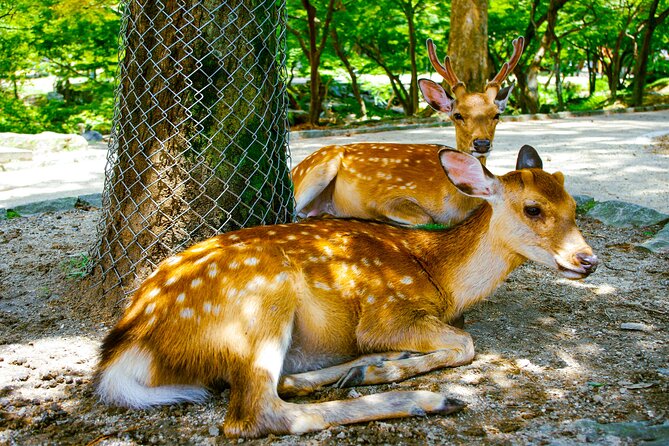
Nara Park is the heart of the Nara portion, and it is easy to see why. You are stepping into a space where wild deer are essentially coexisting with people, relaxing in nature, in temples, on roads, and around just about everything. The guide gives you local context so you are not just seeing cute animals, you are understanding why this place matters.
You have about one hour here, and that time is about right for first impressions plus photos. The park is free, so you can spend that hour without doing math in your head. It also gives you a reset before the more structured stop at Todaiji.
One thing to consider: this park can feel crowded, especially where deer and people converge. If you want deer photos without the crush, you will do best when your guide times walks through the park smartly.
Osaka Castle in 20 minutes, and why that short stop can be enough
Osaka Castle is a classic symbol of Osaka and, importantly, it is not a full-day project. You get about 20 minutes, and that is a good match for travelers who want the iconic exterior and main context without spending half the day waiting in lines and walking long loops.
The castle ties into stories that go beyond architecture. You will hear about samurai history, the founder shogun story, and why the castle has been a major emblem for more than 400 years. The timing also helps you avoid drifting into fatigue before the city districts that really power Osaka’s vibe.
A consideration: if you are the type who wants every exhibit, this will not be the deep-dive version. But for a one-day Osaka and Nara combo, Osaka Castle is the “yes, I saw it” moment that also gives you historical anchors for everything else you will notice later.
Same corner of Japan, a different kind of day:
- Kyoto Geisha Walking Tour: Gion District & Hidden Gems
★ 4.7 · 3,273 reviews - Kyoto: Tea Ceremony Ju-An at Jotokuji Temple
★ 4.9 · 3,207 reviews - Kyoto: Gion Magical Night Walking Tour with Geisha Trivia
★ 4.9 · 2,393 reviews - Kyoto: 45-Minute Tea Ceremony Lesson Experience
★ 4.3 · 2,378 reviews
Yoshikien garden stop for a slower, softer Osaka moment
Right after castle time, you get a break in pacing with Yoshikien, a Japanese garden. You are there about 15 minutes, which means you get the highlights without turning it into a long quiet retreat.
This garden is described as having distinct areas with seasonal flowers and trees, plus Japanese representative mosses that look good in any season. You will also be guided to a traditional section, so it is not just a casual stroll. It is designed as a small interlude that changes your mental mode from “big landmark” to “taste of aesthetics.”
Even if the time is short, I find this kind of stop useful. It helps you avoid the feeling that the day is only about photo spots and shopping streets. You get one calm pocket before the city’s neon and crowds.
American Village and Osaka youth energy, plus the city’s other faces
Osaka is not one single mood. This itinerary reflects that by mixing youth districts with iconic city corridors.
You visit American Village, a neighborhood known for an atmosphere compared to Tokyo youth areas like Shibuya and Harajuku, but with an Osaka twist. The point is less about exact names and more about style. You feel the city’s younger rhythm, street fashion, and nightlife energy in a way that feels different from classic sightseeing zones.
From there, the tour flows through other central shopping and entertainment areas. There is a stop described as the Akihabara of Osaka, known for electronics and anime, so you are likely to recognize it as a concentrated fandom zone rather than a broad city sector.
These stops are short, but that is intentional. In a one-day plan, the value is that you get a sense of what Osaka tastes like, then you move on while your energy is still high.
Todai-ji Temple and the Daibutsu ticket you must plan for
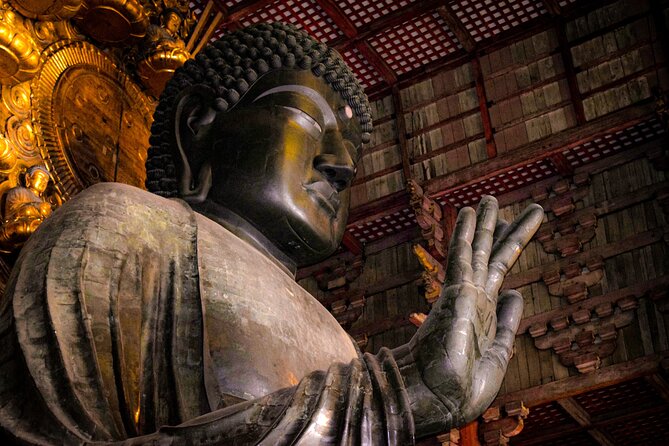
Todai-ji is the anchor stop for the Nara side, and it is the one place where the admission fee matters. You spend about one hour at the temple, and the big practical note is that Todai-ji admission is not included. The fee is listed as ¥800 per person.
Why it is worth that extra budget: Todai-ji is described as the biggest historical wooden architecture in the world, with the biggest Buddha statue inside. It is also framed as one of the most important Buddhist temples to Japanese people, with a tradition of about 1400 years.
You will also get the kind of context that makes the scale feel less abstract. Big spaces can become “wow, huge” and then drift away. With a local guide, you get the religious and historical meaning, which helps the stop land.
Practical consideration: in peak hours, big temples can feel packed. Your guide’s timing choices help, but you should still expect some crowding. If you want maximum quiet time inside, plan to be flexible and follow the guide’s pacing.
Dotonbori, Shinsaibashi arcades, and finding Osaka food fast
Osaka’s famous energy shows up at Dotonbori, also tied to the Shinsaibashi area. You get a focused visit about 15 minutes, and it is enough time to understand why this district is the poster child for Osaka street life.
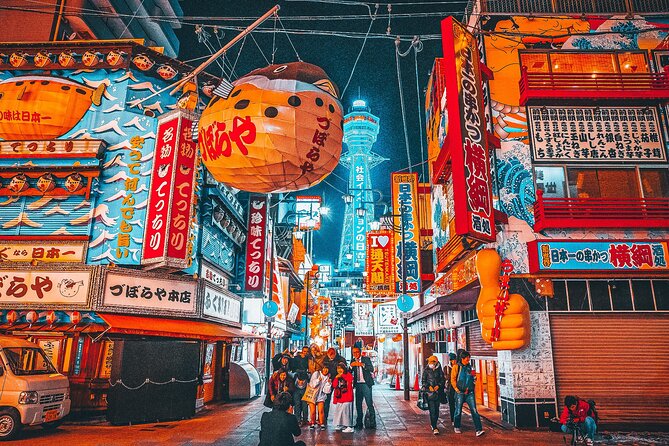
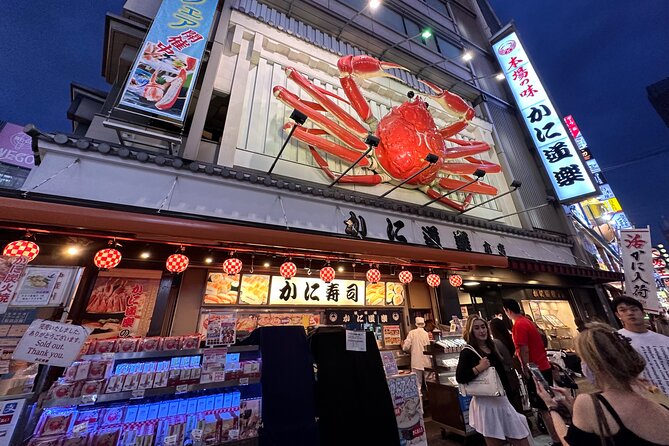
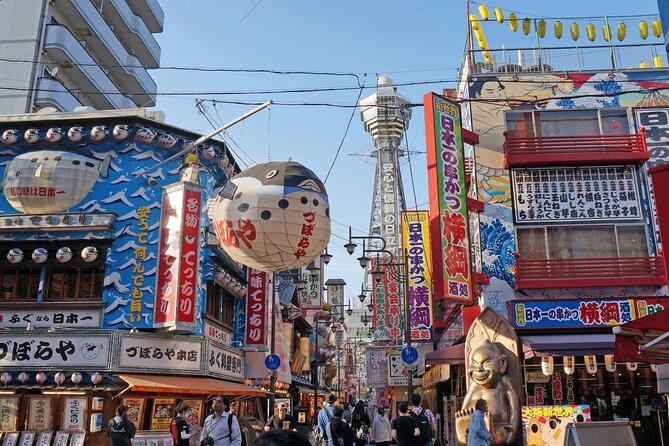
Dotonbori is known for neon riverside views, the running man sign, and long shopping energy. It is busy, loud, and very photo friendly, which is exactly why it lands here in the middle or later part of the schedule. You want that daytime-to-night transition feeling, even if the tour does not treat it like a full evening stroll.
Next, you pass through a crowded shopping arcade area, described as Shinsaibashisuji Kita Shotengai, and it is said to be one of the most crowded arcades in Japan, compared to Shibuya crossing. If you like people watching, this is a fun stop.
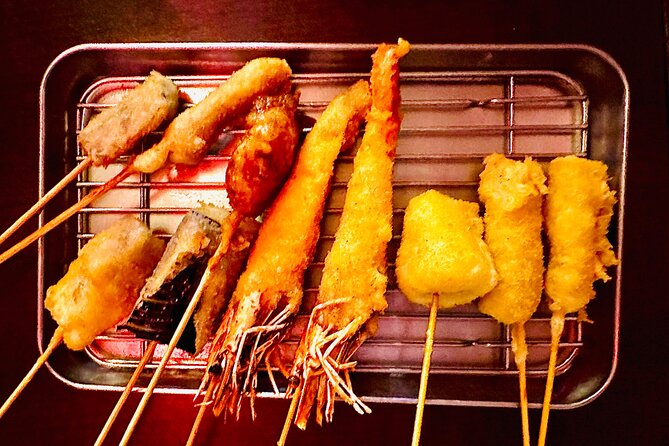
Then you move toward Tsutenkaku Hondori Shopping Street, a symbolic Osaka street known for unique shops and lively street scenes. This is one of the best places to lean into Osaka’s street food culture. The tour calls out trying takoyaki, plus you get a walk through with billboards and that friendly chaos Osaka is famous for.
If you care about food, listen to what your guide suggests. The itinerary includes dinner time and a local restaurant guide, and that guidance is where you avoid the usual tourist trap of picking the first menu you see.
The red-line district stop, how to see it responsibly
One stop on the route mentions a darker side of Osaka: the so-called red-line district, described as a place where you might see school-uniform themed street-front workers waving hands from traditional Japanese houses.
I am glad this is included, but I also think it deserves a careful mindset. This is not a casual shopping street. It is a real part of the city’s nightlife reality, so treat it with respect, keep your distance, and take photos only if the environment clearly supports it and you are not intruding.
A quick advantage of having a guide here: your guide can keep the stop short and contextual, so you do not end up stuck in a scenario that feels uncomfortable. The itinerary suggests it is a brief look rather than a long exploration, and that is likely the right approach.
Todai-ji Shoro bell tower and the 8 pm sound idea
To close the loop on Nara, the tour includes Todai-ji Shoro (Bell Tower). You spend about 10 minutes here, and it is free.
This bell tower stop is interesting because of the bell story: the bell is described as one of the top three bells in Japan, loud enough to be famous, with a 1300-year-old bronze bell. It is said to be rung by a monk every 8 pm, and there is a humorous bit in the description that it never gets hit on target, yet it sounds for three days. Even if you are not there at the exact moment, the context makes the stop feel more meaningful than just another tower photo.
Dinner time and local restaurant guidance, what is included and what is not
You get dinner time and a local restaurant guide. That means your guide helps steer you to a place that fits what you want, and your evening plan feels smoother than trying to decode menus mid-walk.
What is not included is the dinner fee itself. You should also know lunch time is not included. This is important for budgeting, because if you do not plan meals, the day can quietly become more expensive than you expect.
In many one-day city tours, food guidance is vague. Here, the structure is better because dinner is built into the schedule and guided. If you are picky, or if you want something specific like ramen or comfort food, a local guide can usually make the call quickly.
Price and value: is $300.61 a fair deal?
The listed price is $300.61 per group with an indicated up to-one grouping. That sounds steep if you compare it to bus tours, but it makes more sense when you remember what you are buying.
You are getting:
- a private air-conditioned vehicle,
- a full English guide and driver,
- fuel and highway fees,
- parking fees,
- free pickup and drop-off across Kyoto, Osaka, and Nara,
- and guidance for dinner selection.
For solo travelers, $300-ish is basically paying for convenience plus a private pacing control. For small groups, the value improves if the vehicle can be shared, since the tour is private but the Nissan Serena option can fit 2-6 pax.
The one cost you should add to your mental budget is Todai-ji admission (¥800 per person). Dinner is also on you. Once you include those, you can decide if the private-door convenience beats spending time on trains and doing transfers yourself.
My practical take: if you want to see both cities in one day and you do not want logistics stress, this is the kind of “pay for ease” that often feels worth it.
Who should book this tour, and who should skip it
This tour fits best if you:
- want Osaka and Nara in the same day without figuring out transport,
- like big highlights plus a few district moments that show city character,
- enjoy having a guide help with context and photo timing,
- and plan to take comfort seriously, since the van is air-conditioned and private.
Skip it or consider a shorter focus if you:
- hate busy crowds and want a quiet, slow schedule,
- want to spend long hours inside major sites beyond a one-hour temple visit,
- or would rather spread Osaka and Nara over separate days to reduce rush.
If you are doing Kyoto plus Osaka plus Nara all in one trip, this day tour can be a smart way to “check in” on the big cultural sites and the city buzz without sacrificing all your other plans.
Should you book this one-day Osaka and Nara private van tour?
Yes, if you want a high-return day with door-to-door pickup, a local English guide, and a route that mixes sacred Nara with lively Osaka. The schedule is built to hit the biggest names like Nara Park, Osaka Castle, Todai-ji, and Dotonbori, and it also sprinkles in the street-level neighborhoods that make Osaka feel modern and fun.
Not for you if you want lots of downtime or deep museum time. In that case, splitting into separate Osaka and Nara days is a better match.
Use one simple decision rule: if you value convenience, context, and a private pace more than slow wandering, book it. If you value calm and silence most, trim the scope.
FAQ
What is the start time for this Osaka and Nara day tour?
The tour starts at 1:00 pm.
How long does the tour take?
The duration is about 6 hours 30 minutes to 7 hours 30 minutes.
Is admission to Todai-ji included?
No. Todai-ji admission is not included and is listed as ¥800 per person.
What vehicle will I ride in?
You travel in an air-conditioned private car, either a Nissan Serena (2-6 pax) or a mini convertible (1 pax).
Do I get pickup and drop-off included?
Yes. The tour includes free pick up and dropping off anywhere in Kyoto, Osaka, and Nara cities. Pickup and drop-off points can be different.
Is there a guide and is it in English?
Yes. It includes a full English guide and driver from local.
Does the tour include dinner?
The tour includes dinner time and a local restaurant guide, but dinner costs are not included.
Is this a private tour or a shared group?
This is a private tour. Only your group will participate.
Can I cancel for a full refund?
Yes, you can cancel up to 24 hours in advance for a full refund.
Fresh options around Kyoto
- Kyoto Aquarium Admission Ticket★ 4.7 · 12 reviews
- Kyoto Gion Photoshoot – Private Session | Pro Photographer★ 5.0 · 12 reviews
- Gyoza Cooking Class in Kyoto: Traditional Japanese Dumplings★ 5.0 · 12 reviews
- Kyoto: Guided Food Tour with 12 Dishes & 3 Drinks★ 5.0 · 12 reviews
- Kyoto: Avoid the Crowds at the Hidden Gems of Arashiyama★ 4.9 · 13 reviews
- Kyoto Early Bird English Tour: Gion & Higashiyama(Private opt)★ 5.0 · 13 reviews
- Otsu-e Folk Art Workshop & Local Culture Walk Near Kyoto★ 5.0 · 13 reviews
- Kyoto, Osaka, Nara Full Day tour by Car English speaking Driver★ 3.5 · 13 reviews
1-Day Tours, compared.
Mt Fuji and Hakone 1-Day Bus Tour Return by Bullet Train
Read our review →
Mt Fuji & Hakone Cruise, Drum Show Bullet Train 1 Day from Tokyo
Read our review →
Peaceful Hiroshima & Miyajima UNESCO 1 Day Bus Tour
Read our review →
Fushimi Inari, Kinkakuji, Bamboo Grove 1 Day Bus Tour
Read our review →
Browse the lists this tour appears in