
Reviewed · SAMURAI & NINJA EXPERIENCES
Authentic Ninja Weapon Forging Experience in Kyoto
Your hands make the ninja tool. In Kyoto, Atelier NIN turns you into a real sword-shop trainee, with step-by-step forging and shaping of a shuriken or kunai, then kanji engraving and an authentic dark finish. I love that it is hands-on from start to finish, not a “watch and clap” experience.
I also like the fact that you leave with something you can actually travel with, thanks to a storage box and bag. One drawback to weigh: the workshop price is not cheap, and if you prefer very detailed, slow instruction, you may want to pay extra attention, because a small number of past participants felt the directions were sometimes vague.
Key moments you will remember
- Choose your weapon: three shuriken styles or one kunai, so your souvenir feels personal
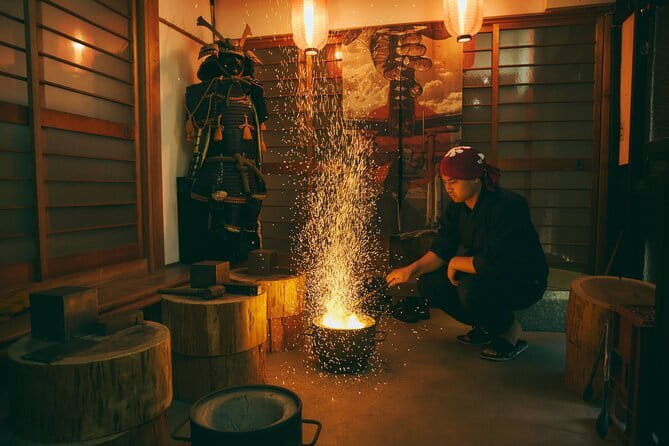
- Heat at 800°C: you get to experience the core forging step, hammering glowing steel
- Shaping with a belt sander: you refine and sharpen your weapon using proper tools
- Kanji engraving: pick a character and have it engraved precisely
- Blackening plus final polish: a protective dark finish, then shining up the result
- Small-group feel: maximum 25 travelers, with friendly, high-energy staff support
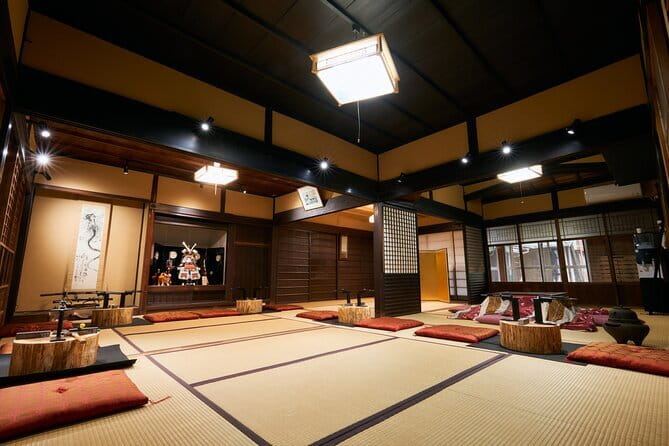
Suiting up at Atelier NIN, Kyoto’s ninja workshop vibe
Kyoto has plenty of temples and enough souvenir shops to power a small city. This is different. Atelier NIN is a working-feeling studio where you put on a traditional blacksmith uniform (samue), wrap a tenugui head cloth, and get pulled into the process like you belong there.
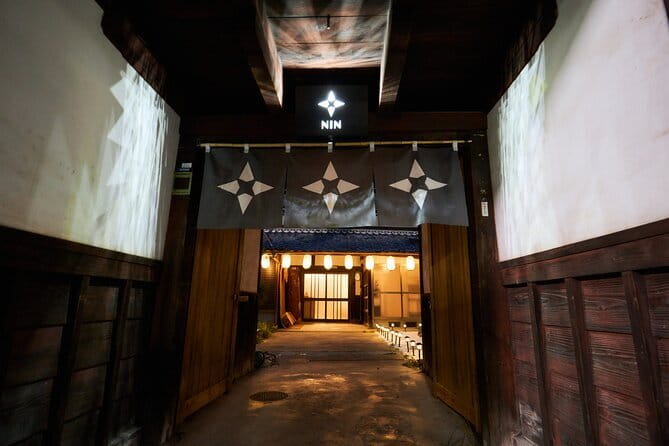
The experience runs about 2 hours 30 minutes and keeps group size capped at 25 people. That matters because this kind of hands-on making goes faster when you are not fighting the room for attention. You also get a mobile ticket, and your session starts and ends at the same meeting point, studio NIN (八瀬168-1 Yasenosechō, Sakyo Ward, Kyoto).
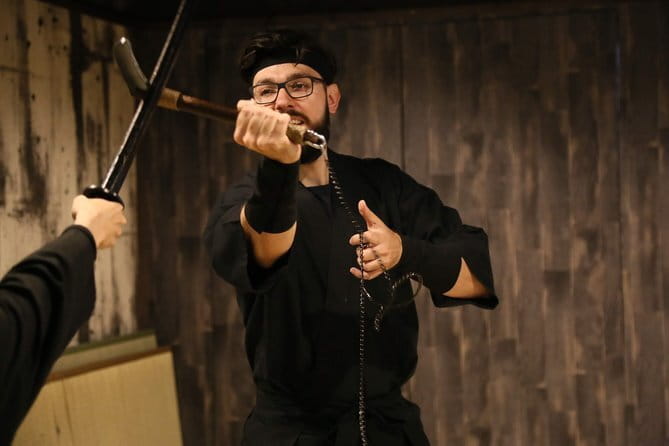
The “ninja” part is not just costumes. You are making a weapon, learning what it was for, and talking through how ninja weapons fit into the broader history of martial culture. You still get fun energy, but it is tied to real craft steps.
Practical tip: treat this like a workshop day, not a quick photo stop. When staff are guiding you through the furnace and metal shaping, they move with purpose. Staying mentally present will make it feel smoother.
More Samurai & Ninja Experiences in Kyoto
- Kyoto Samurai Experience
★ 5.0 · 1,294 reviews - Kyoto: Kendo and Samurai Experience with Uniform and Gear
★ 4.9 · 815 reviews - Kyoto: Samurai Sword Class by Experts in Traditional Arts
★ 4.9 · 657 reviews
Where the studio is, and what the “moderate fitness” note means
The studio is in Sakyo Ward, at Yasenosechō (八瀬), which is not the exact same walk-everywhere area as the most famous Kyoto sights. The good news is it is described as near public transportation. The reality is that you might still want a taxi, depending on where you are staying and your tolerance for transfers.
Also note the activity calls for moderate physical fitness. That does not mean you need athlete legs, but the work involves handling tools and maintaining focus through a sequence of motions. If you tire easily, focus on good pacing and listen for any simpler options the staff might suggest during sharpening or grinding steps.
In past sessions, participants have praised the instructors for being organized, friendly, and patient. One person also said the instructions were sometimes not detailed enough, so I recommend you watch the demo closely and ask a quick question if something does not feel clear at your station.
Step-by-step making: choosing shuriken or kunai first
After you suit up, you move into the fun decision point: what ninja tool are you making? You can choose one kunai, or select among three shuriken styles, each with its own shape and feel. That choice is more important than it sounds. When you pick your weapon early, the rest of the session becomes “your pattern,” not generic crafting.
You also get to personalize the final piece later with kanji engraving. So even if two people choose the same weapon style, you can end up with very different results. This is one reason the souvenir feels satisfying, not disposable.
In reviews, people specifically highlighted the experience as doable for first-timers. That matches the workshop’s setup: there is no requirement for prior forging skill. The staff teach you how to handle the process safely and effectively.
Forging the core step at 800°C: heat, hammer, sparks
The heart of the whole activity is forging. You heat your selected metal in an 800°C furnace, then hammer the glowing steel as sparks fly. This part is the “I am actually doing the work” moment.
Why it is valuable: most travel experiences about ninja culture are stories, weapons in glass cases, or movie references. Here, the craft teaches you how metal behaves when it is hot and what shaping means when you are controlling the material in real time. You are not just learning facts, you are building the mental model that makes the history make more sense.
Even if you have never held a forging hammer before, the way the workshop is structured lets you participate at a pace that makes sense. Past participants described the process as organized and fun, and they repeatedly emphasized that they were able to complete the techniques needed to make the weapon.
Safety is part of the pitch. The workshop is set up to let you learn “how to heat, hammer, and shape” under guidance. Still, treat the experience like a workshop, not a spectacle. Listen for safety cues and keep your attention on the metal, the tool, and the staff member next to you.
More samurai and ninja experiences in Kyoto:
- Skip the lines Basic Ticket at SAMURAI NINJA MUSEUM KYOTO
★ 4.5 · 632 reviews - Ninja 1-hour Hands-on Lesson by Japanese master in Kyoto -Entry
★ 5.0 · 489 reviews - Kyoto: Ninja Weapon Forging Experience
★ 4.8 · 478 reviews - Kyoto: Samurai Kenbu Traditional Sword Dancing Show
★ 4.5 · 426 reviews
Shaping and sharpening: turning rough metal into your blade

Once the forging step is done, you shift into refinement. The workshop uses a professional belt sander to refine and sharpen the metal. If forging is the dramatic, high-heat part, this is the precision part where the weapon starts looking like the object you imagined.
This is also where you will notice how hands-on help can make a real difference. One review singled out staff support, including help to improve a kunai’s symmetry. That tells you the instructors are not only running the process, they are checking the details.
One small drawback to watch for: the same review section that praises clarity also includes at least one critique that directions can be a bit vague at times. If you are unsure mid-step, do not wait. Ask for confirmation right away, because the whole workflow is linked. Getting the shape right early saves frustration later.
Kanji engraving and the ninja knowledge session
Your finished metal does not stay plain. You choose a kanji character, then staff engrave it precisely. That is the kind of customization that feels meaningful because it ties your personality to the object.
Right after or around the engraving time, you get a ninja knowledge session. The focus is on ninja history, weapons, and what the workshop frames as secret techniques. It is not meant to replace a textbook, but it gives you context while your hands are still learning the craft steps. That timing helps. You are less likely to forget what you made because you are learning what role weapons like this played.
In past feedback, people highlighted that they learned about the purpose of different weapons. Others praised the staff for being enthusiastic and high energy, which makes the history talk feel like part of the day rather than a separate lecture.
If you enjoy understanding the why behind the what, this is one of the strongest parts of the experience.
Blackening, polishing, and the satisfaction of a finished piece
After the shaping and engraving, you apply a special solution to blacken the steel. The solution is described as protective, and it also creates that dark, authentic finish associated with real tools.
Then comes the final polish, where you bring out the shine. This sequence matters because it changes your weapon from “made of metal” into something that looks like a real crafted object you would want to display.
In reviews, this finishing step is frequently tied to the souvenir value. People liked that they did not just walk away with an imitation. They walked away with a weapon-shaped product that looks intentional and travel-ready.
Taking your weapon home: boxes, bags, and checked-bag reality
The included materials mention a clean box and bag to take home. That detail matters a lot in a place like Kyoto, where souvenirs often turn into fragile glass problems.
Several participants specifically said they were able to pack the finished weapon in checked luggage. That is not a guarantee for every airline, but it is a strong hint that the workshop packaging is designed with travel in mind. I would still pack it carefully, treat it like a tool, and follow any airline rules you are under.
Also, since the activity ends back at the meeting point, you do not need to coordinate a long, complicated commute mid-way. You can plan your rest of the day around the workshop ending, then head back out with a clear return plan.
Price and value: what $151.92 buys you in real craft time
At $151.92 per person, this is a premium Kyoto workshop. The honest question is: is it worth it?
Here is what makes it feel like value for many people:
- You are paying for a full craft sequence, not a single demo. Heating at 800°C, hammering, belt-sanding, engraving, blackening, and polishing are all part of the plan.
- You leave with a custom, take-home object, plus a box and bag meant for transport.
- The staff attention is a repeated theme. People mention help with symmetry, friendliness, and high energy. When you are paying for craft, that human guidance is part of the value.
Where value might feel weaker:
- The time is still about 2.5 hours. If you expected a slower class with extra troubleshooting and lots of written instruction, you might feel the pace is tight.
- One review criticized the experience as pricey for what they believed was limited explanation, and they did not feel they did much of the making. That is not the majority experience, but it is a signal that your expectations matter.
My practical take: if you want a one-of-a-kind souvenir made by your hands, this is likely to satisfy you. If you want a weapon history tour with deep lectures and museum pacing, you may find it too hands-on for your taste.
Who this is best for, and who should reconsider
This is a great fit if you:
- want an authentic craft experience in Kyoto, not just a museum stop
- enjoy making things and want a take-home object
- like learning culture in context, while you are actively working
- travel as a family or group, since the format is fun for both adults and teens, and staff have been praised for keeping the session engaging
The experience also seems friendly for newcomers. Reviews often mention no prior experience needed, plus staff being helpful with technique.
You might reconsider if:
- you dislike tool-based activities or you get tired quickly during hands-on work (the workshop recommends moderate physical fitness)
- you strongly prefer very detailed step-by-step instructions at all times
- you are budget-first, because this is priced as an event you will remember, not a low-cost activity
A final check before you book
Should you book this ninja weapon forging workshop with Atelier NIN? I would say yes if you are the type of traveler who values doing over watching and you want a personalized Kyoto souvenir that you can actually pack and bring home.
Book it when you:
- want a hands-on craft memory tied to Japanese ninja culture
- are excited about the sequence of forging, engraving, blackening, and polishing
- appreciate high-energy instruction and a small-group workshop setting
Skip it if you want something more like a traditional tour where you mostly listen and observe, or if the idea of tool work makes you nervous. In that case, you may be happier with a history-focused museum day.
If you fit the first group, this is one of those rare Kyoto experiences where you leave with proof you were there, not just photos.
FAQ
How long is the ninja weapon forging experience in Kyoto?
It runs for about 2 hours 30 minutes (approx.).
Do I need experience to make a shuriken or kunai?
No. The workshop is designed for beginners, and skilled craftsmen teach you the techniques.
What weapons can I make during the workshop?
You can choose one of three shuriken styles or a kunai.
What’s included in the price?
Specialized tools are provided for use during the workshop, uniforms are rented for the session, and you take your finished piece home in a clean box and bag.
Where is the meeting point and where does the tour end?
You meet at studio NIN, 八瀬168-1 Yasenosechō, Sakyo Ward, Kyoto, 601-1254, Japan, and the activity ends back at the meeting point.
Is free cancellation available?
Yes. You can cancel for a full refund up to 24 hours before the experience starts. If you cancel less than 24 hours before, the amount is not refunded.
Fresh options around Kyoto
- Kyoto Aquarium Admission Ticket★ 4.7 · 12 reviews
- Kyoto Gion Photoshoot – Private Session | Pro Photographer★ 5.0 · 12 reviews
- Gyoza Cooking Class in Kyoto: Traditional Japanese Dumplings★ 5.0 · 12 reviews
- Kyoto: Guided Food Tour with 12 Dishes & 3 Drinks★ 5.0 · 12 reviews
- Kyoto: Avoid the Crowds at the Hidden Gems of Arashiyama★ 4.9 · 13 reviews
- Kyoto Early Bird English Tour: Gion & Higashiyama(Private opt)★ 5.0 · 13 reviews
- Otsu-e Folk Art Workshop & Local Culture Walk Near Kyoto★ 5.0 · 13 reviews
- Kyoto, Osaka, Nara Full Day tour by Car English speaking Driver★ 3.5 · 13 reviews
Samurai & Ninja Experiences, compared.

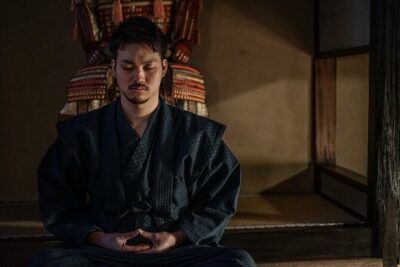
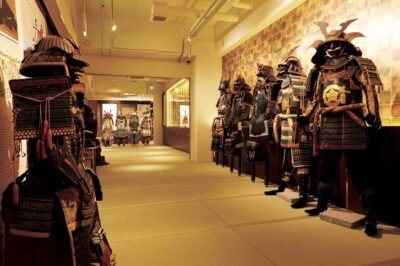
Samurai Ninja Museum Guided tour and Experience
Read our review →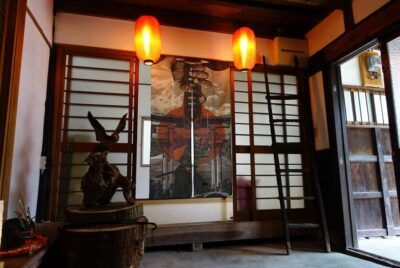
Kendo and Samurai Experience with Uniform and Gear
Read our review →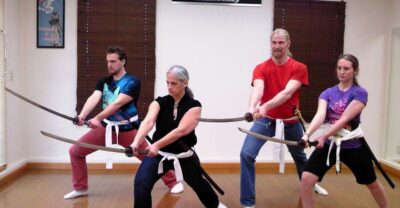
Samurai Sword Class by Experts in Traditional Arts
Read our review →
Skip the lines Basic Ticket at SAMURAI NINJA MUSEUM KYOTO
Read our review →
Samurai Sword & Archery Class from Samurai Descendant
Read our review →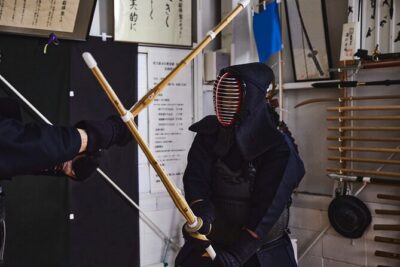
Browse the lists this tour appears in