
Reviewed · MT FUJI TOURS
Tokyo: Mt. Fuji, Arakurayama Sengen Park, Oshino Hakkai Tour
One day, four Mount Fuji moments. This tour strings together classic views, and Arakurayama Sengen Park gives Mount Fuji framed by the five-story pagoda. I love that the whole experience shifts with the seasons, from cherry blossoms to snow-capped rooftops.
I also like the slower, quieter feel at Oshino Hakkai, where clear spring water makes Mount Fuji reflections feel close and calm. The main drawback to plan for is walking time and stairs, plus the fact that Oishi Park is only open on weekdays and can be canceled if traffic throws off the schedule.
Key things I’d zero in on
- Arakurayama Sengen Park offers a five-story pagoda photo setup with Mount Fuji in the same frame
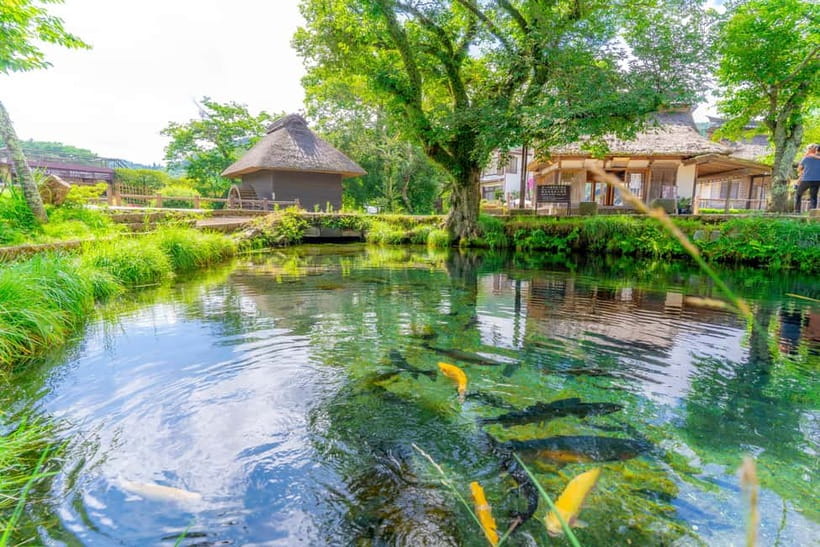
- Oshino Hakkai is built around spring water scenery and peaceful pond views
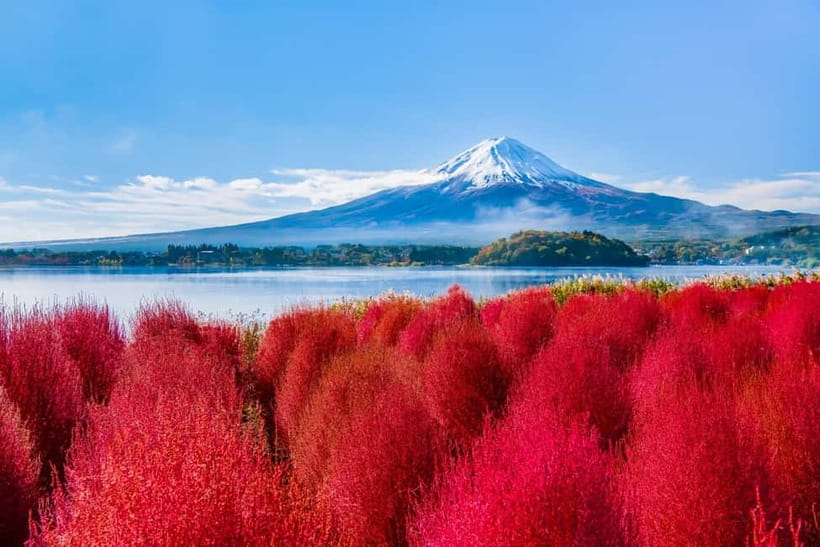
- Oishi Park gives Lake Kawaguchi and Fuji views, but weekday-only rules affect your odds
- Saiko Iyashi-no-Sato Nenba brings a thatched-roof village feel, with winter steam from hot springs
- English-speaking guide support, with a note that some vehicles may switch to driver commentary
From Shinjuku to Fuji: how the timing really feels
This is a long day. The tour runs about 570 minutes, with Shinjuku as your start and finish, and multiple bus rides that put you into the Fuji area early enough to enjoy the main viewpoints.
You will depart from the front of Kogakuin University Shinjuku Station West Exit. There is a short walk, then you are looking for a Wonder Tour flag near that west-side area, and it is important to arrive on time since the operator does not contact you in advance.
Bus time matters because you will be sightseeing more than eating or resting. The route includes several free-time windows, so you can move at your own pace on foot, but keep in mind there are long stairs and uphill sections in parts of the day.
More Mt Fuji tours from Tokyo:
- Mt Fuji and Hakone 1-Day Bus Tour Return by Bullet Train
★ 5.0 · 26,383 reviews - Mt Fuji & Hakone Cruise, Drum Show Bullet Train 1 Day from Tokyo
★ 4.0 · 7,413 reviews - Tokyo Mt Fuji 5th St & Hakone Cruise Bus Tour w/Bullet Train
★ 4.4 · 5,024 reviews
Arakurayama Sengen Park: the pagoda viewpoint that changes all year
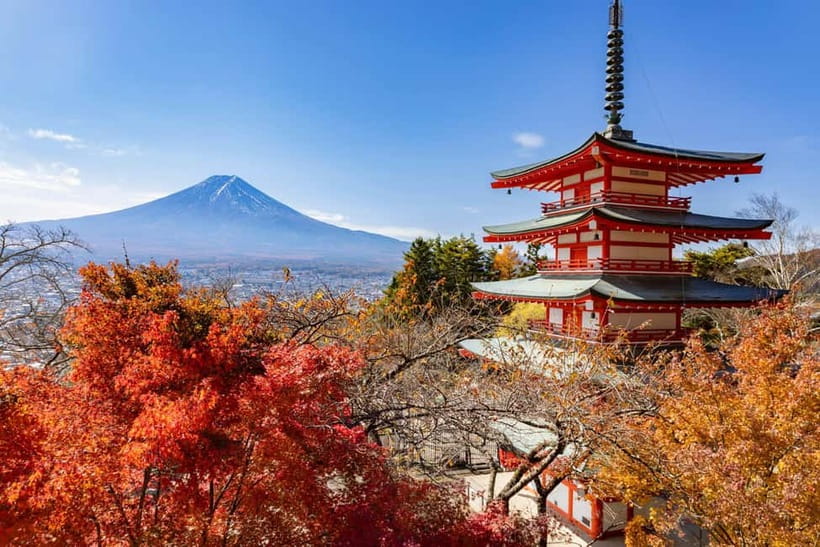
Arakurayama Sengen Park is where Mount Fuji turns into a postcard. You get about an hour of free time at the park, and the focus is the five-story pagoda with Mount Fuji in the background.
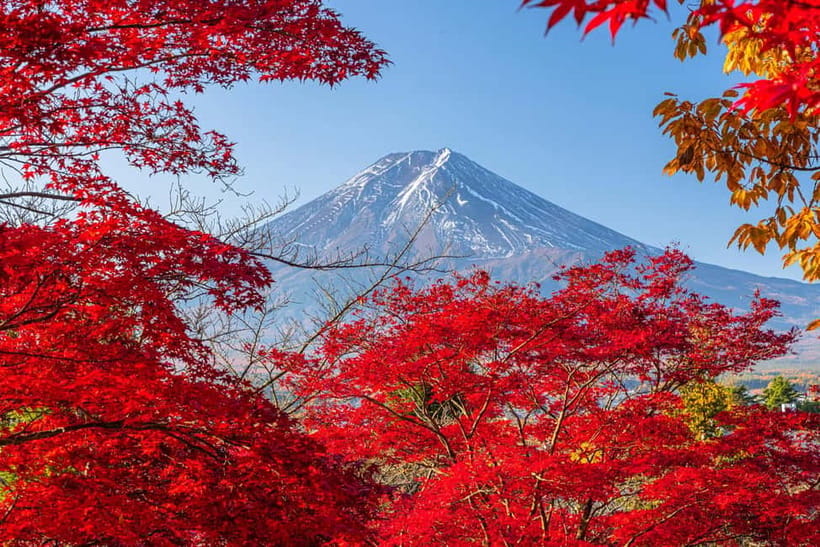
The seasonal details are a big part of why this stop works. In spring, cherry blossoms bloom across the park, and the pagoda plus Fuji can look like a staged photo. In summer, the hillside turns green, and Fuji often pops against a clearer sky. In autumn, red leaves and orange maples create a warm, romantic color mix around the pagoda. In winter, snow can cover both the roof and the mountain peak, and the contrast tends to look sharp and dramatic in crisp air.
Two practical notes I appreciate here. First, the viewpoint is popular, so expect crowds at peak times. Second, this is a place where your best photos often come from walking a bit and finding the right angle, so wear shoes you feel stable in.
If you are trying to time it for blossoms, the area around Mount Fuji typically runs from late April to early May, though weather can shift the bloom dates. For autumn color, the best period is usually late October to early November, again depending on what the weather does that year.
A quick culture reset at Hikawa Clock Shop
Between major scenery stops, there is a shorter break: Hikawa Clock Shop with about 30 minutes of free time. This is a good moment to stretch your legs, grab something small, and get your bearings before the next part of the day.
I like that it is short. You are not stuck waiting around, and you still have time later for the water-based scenery and the thatched-roof village.
It is also a reminder to keep your cash handy. The tour asks you to bring cash, and you will likely want it for any snacks or souvenirs along the way.
Oshino Hakkai: spring water ponds and calm Fuji reflections
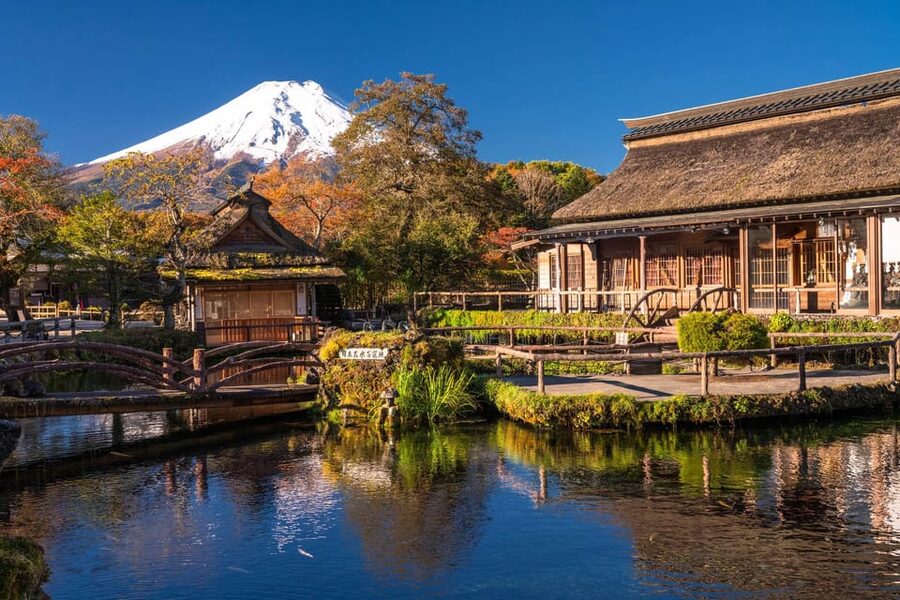
Oshino Hakkai is one of the most atmospheric stops on the itinerary. You get about 1.5 hours of free time here, and the center of it all is the spring water scene around the ponds and water pockets.
In spring, cherry blossoms can bloom near the spring water, so you get both Fuji and soft pink color in the same view. In summer, the water can look clear and cool, which makes the area feel like a break from the heat. In autumn, red leaves fall gently into the water scene. In winter, snow can blanket the village while the water stays crystal clear, which creates that crisp, quiet feeling.
This stop is where the pace feels like it slows down. After bus rides and a pagoda viewpoint, Oshino Hakkai gives you time to stand, look, and take photos without needing to race.
One consideration: this is a popular Mount Fuji area, so there can be foot traffic. Still, the water setting helps it feel more relaxed than you might expect from a sightseeing circuit.
A few more Tokyo days worth comparing
- 1-Day Tokyo Bus Tour
★ 5.0 · 14,250 reviews - Tokyo: TOKYO SKYTREE® Admission ticket
★ 4.5 · 11,192 reviews - Tokyo: teamLab Planets TOKYO Digital Art Museum Entry Ticket
★ 4.6 · 9,779 reviews - Tokyo: Sumo Show Experience with Chicken Hot Pot and a Photo
★ 4.8 · 6,678 reviews
Oishi Park: Lake Kawaguchi views with strict weekday timing
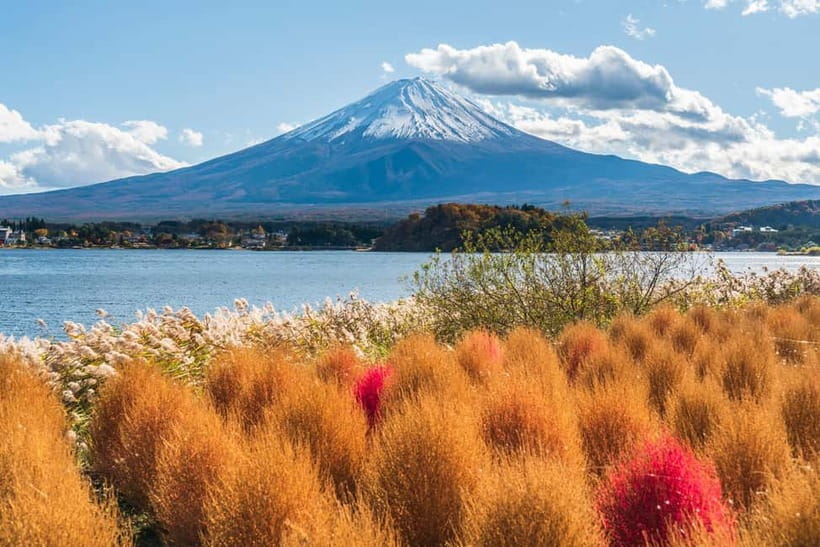
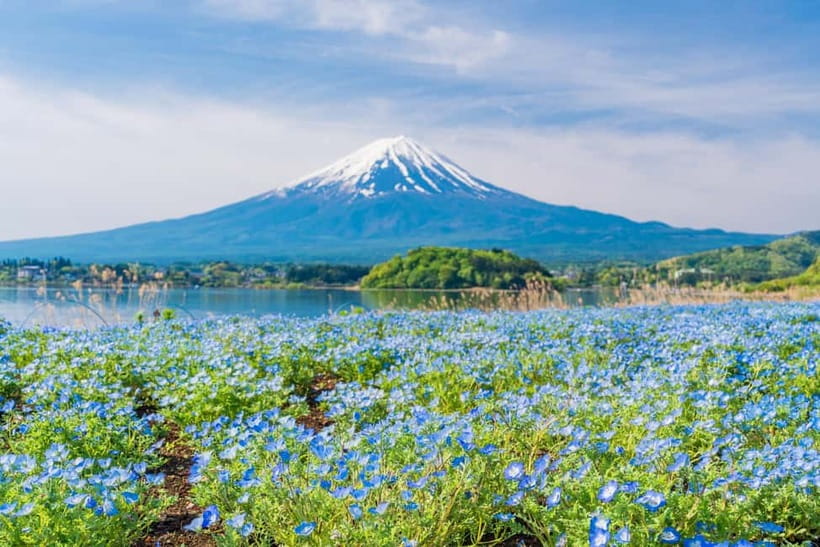
Oishi Park is where you get classic Lake Kawaguchi scenery with Mount Fuji in the distance. Your time here is short, about 30 minutes, and it is structured as a photo stop plus free time.
The season details are excellent. In spring, tulips and moss phlox decorate the lakeside, giving you a colorful foreground. In summer, lavender can fill the lakeshore with fragrance and color. In autumn, golden grass appears and you might spot Mount Fuji’s first snow in the distance. In winter, the lake can reflect snowy mountain views, and it can feel very quiet when the light is right.
Now the big practical catch: Oishi Park is only open for visits on weekdays. It is closed on weekends, holidays, and during Golden Week (April 29 to May 5). Even on weekdays, the visit may be canceled if traffic causes delays.
If Oishi Park is a top priority for you, plan your trip so you are more likely to land on a weekday. And if you end up skipping it due to timing, do not treat that as a failure. You still get the core Fuji framing at Arakurayama and the spring water scenery at Oshino Hakkai.
Saiko Iyashi-no-Sato Nenba: thatched roofs and winter steam
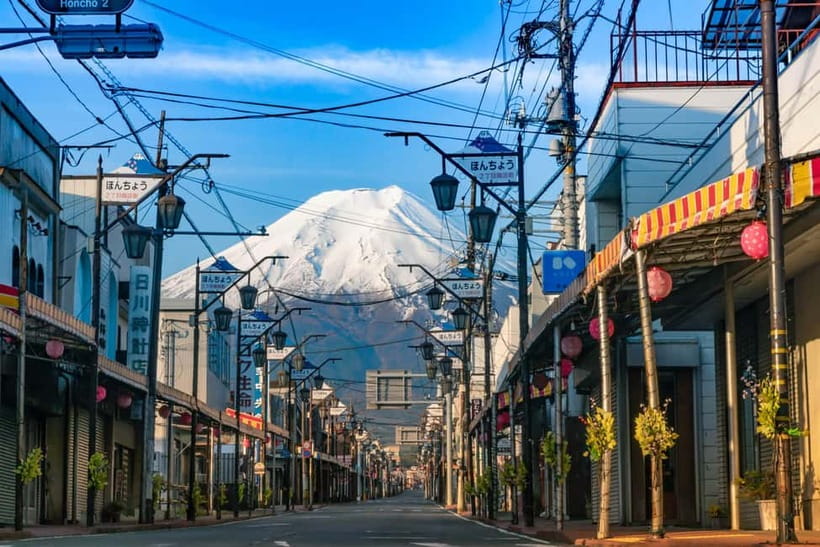
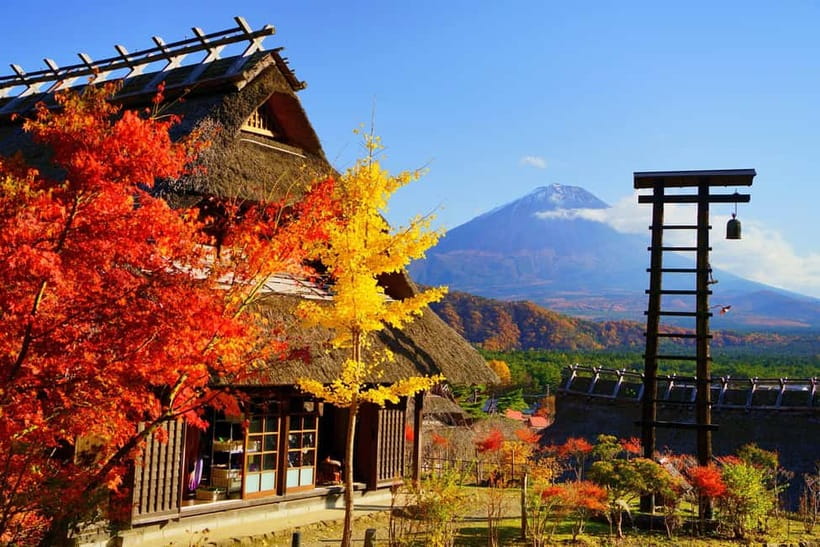
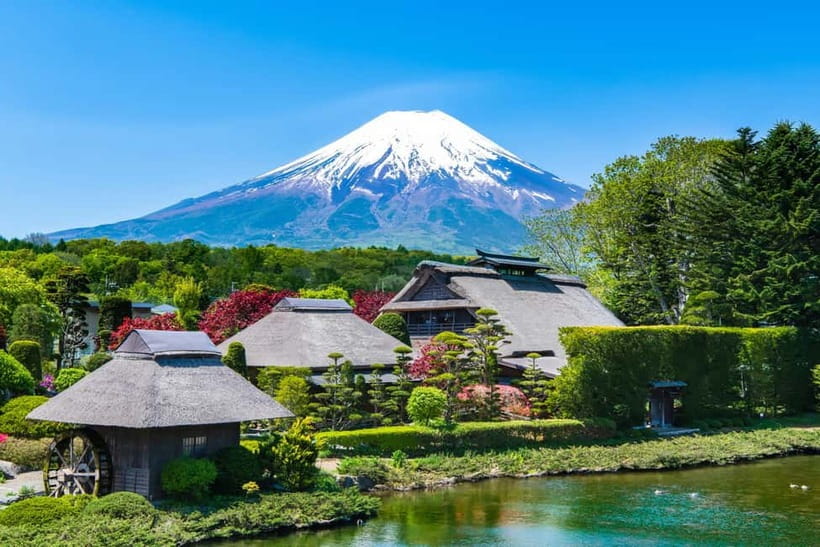
Saiko Iyashi-no-Sato Nenba is the calm, traditional-feeling finish. You get about 1 hour here, and the key vibe is the thatched-roof village atmosphere.
The seasonal feel is striking. In spring, ancient thatched houses set against cherry blossoms can look like a rural time snapshot. In summer, you get rice field scenery and clear streams, plus a fresh mountain-air feeling. In autumn, red leaves highlight the thatched rooftops, and it can feel like you stepped into an old hillside scene. In winter, snow covers the rooftops and steam rises from hot springs, which gives the area a fairy-tale mood.
This stop is a nice match to the earlier water and pagoda views. You start with Fuji framed by architecture, then slow down at Oshino Hakkai, then bring everything back to a human-scale village setting.
Do keep expectations realistic: you will still be walking on uneven ground in places, and winter conditions can make surfaces slippery. Shoes with grip matter.
Transportation and comfort: the small things that make the day work
This tour uses roundtrip transportation, and the schedule includes multiple short bus segments. From Shinjuku to Arakurayama is about 1.5 hours, then it is roughly 20 minutes to Oshino Hakkai, 30 minutes to Oishi Park, 20 minutes to Saiko, and about 2 hours back to Shinjuku.
A long day like this is also about what you do between moments. Meals are not included, so I recommend planning to eat before you leave, then consider snacks for later. The itinerary includes long scenic walks and photo pauses, and when you go hungry, it shows fast.
Also check the guidance on mobility. There are long stairs and uphill sections, and the tour does not recommend participation for seniors who need crutches. The tour is also noted as not suitable for people over 70.
Baggage is another practical factor. Each passenger may bring one suitcase (max 30 kg, max 155 cm total), and you should not store valuables in the bus trunk. The operator also says they are not responsible for loss, theft, or damage.
Guide support: English, Chinese, and what to expect in the vehicle
The tour is listed with a live tour guide in Chinese and English. That is great for explanations, practical advice, and faster decisions about where to stand for photos.
There is one important detail to keep in mind. If you are traveling by Hiace or microbus, the driver may provide Chinese or machine-translated English commentary, and there may be no professional guide included. It is still a guided experience in the sense that someone is handling logistics, but the depth of explanation can vary by vehicle.
I think this is a reason to be flexible. If you care most about the sights themselves, you will be happy. If you want a lot of cultural background for every stop, you may want to double-check what vehicle your departure uses when you book.
Price and value: what $50 actually buys you
At about $50 per person, this is a budget-friendly way to hit multiple Fuji icons in one go. The key value is that your cost includes roundtrip transportation, a ticket to Saiko Iyashi-no-Sato Nenba, and an English-speaking guide (with the vehicle note mentioned above).
What is not included is also important. Meals are not included, and personal expenses are on you. You might also want spending money for water, snacks, and any small purchases during the free-time stops, especially since the tour asks you to bring cash.
When I judge value, I focus on friction. This route is hard to stitch together on your own if you want to avoid transfers and keep a tight schedule. Here, you trade flexibility for convenience, and you get exactly the Fuji circuit most people hope for in a single day.
Who should book this Fuji sampler day
This tour fits best if you want iconic Fuji views without building your own transport plan. It is also a good pick if you like seasonal changes. The itinerary is structured so you will see how Fuji scenes shift across cherry blossoms, green summer tones, autumn leaves, and winter snow.
It also makes sense for people who prefer clear timing. You get free time blocks at each main stop, so you can take your photos and then keep moving.
It may not be the best match if you need a low-walking day. The route includes long stairs and uphill sections, and it is not suitable for those over 70.
Should you book this Mount Fuji day tour?
I would book it if your priority is getting Mount Fuji views at multiple famous points and you want a smooth, guided schedule out of Shinjuku. The combination of Arakurayama Sengen Park, Oshino Hakkai, Oishi Park, and Saiko Iyashi-no-Sato Nenba makes this feel like a well-rounded Fuji sampler, not just one viewpoint.
I would think twice if Oishi Park is a must for you and your travel dates land on a weekend. Weekday-only rules are real, and traffic delays can lead to cancellation even then.
If you want an easy, budget-conscious Fuji day, this is a solid choice. Just pack for walking, bring cash, and aim for the season you care about most.
FAQ
How long is the Tokyo Mt. Fuji, Arakurayama, Oshino Hakkai tour?
The total duration is 570 minutes.
What is included in the tour price?
Roundtrip transportation, a ticket to Saiko Iyashi-no-Sato Nenba, and an English-speaking guide are included.
Are meals included?
No, meals are not included.
Does the tour visit Oishi Park?
Yes, there is a stop at Oishi Park for a photo stop and free time, but it is only for weekdays. It can also be canceled on weekdays if traffic delays affect the schedule.
What languages do I get during the tour?
The tour is provided with live guide support in Chinese and English. In some vehicles, you may receive driver commentary in Chinese or machine-translated English instead of a professional guide.
What should I bring?
The tour guidance says to bring cash.
Is this tour suitable for older travelers or anyone who needs extra mobility support?
The tour notes that it is not suitable for people over 70. It also mentions long stairs and uphill sections, and advises against participation for seniors who require crutches.
Fresh options around Tokyo
- Tokyo: Sumo Morning Practice with Photo Banzuke and Guide★ 4.9 · 34 reviews
- Shinjuku: Private Bar Hopping★ 5.0 · 34 reviews
- [Private]Shinjuku Golden Gai Bar Hopping w/ Japanese Local Guide★ 5.0 · 34 reviews
- Tokyo: Locals´ Secret Food Tour // Eat like a Japanese★ 5.0 · 35 reviews
- Tokyo Traditional Geisha Show and Japanese Fine Dining Experience★ 4.5 · 35 reviews
- Private Drifting Lesson w/ OG Pro Instructor Tokyo Drift Japan★ 5.0 · 35 reviews
- Japanese Cooking and Udon Making Class in Tokyo with Masako★ 5.0 · 35 reviews
- Premium Tokyo Go-Kart Tour in Shibuya to Shinjuku (*IDP Required)★ 4.5 · 35 reviews
Mt Fuji Tours, compared.
Mt Fuji and Hakone 1-Day Bus Tour Return by Bullet Train
Read our review →
Mt Fuji & Hakone Cruise, Drum Show Bullet Train 1 Day from Tokyo
Read our review →
Tokyo Mt Fuji 5th St & Hakone Cruise Bus Tour w/Bullet Train
Read our review →
Mt. Fuji Tour, Hakone Ropeway, Owakudani, Lake Ashi
Read our review →
Mt.Fuji,Kawaguchiko Oishi Park,Arakurayama Sengen Park
Read our review →
Mt. Fuji 5th Station & Hakone Cruise 1-Day Bus Tour
Read our review →
Mt Fuji Top 5 Spots Day Tour: Arakurayama Park,Oshino Hakkai
Read our review →Browse the lists this tour appears in