Reviewed · TOKYO TOURS
Calligraphy Culture SHODO Experience in Tokyo
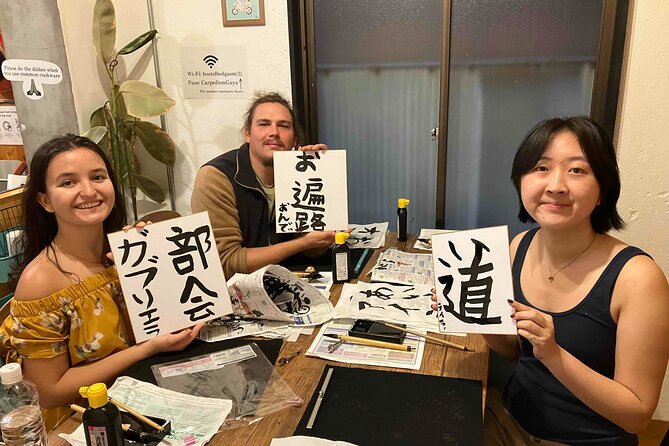
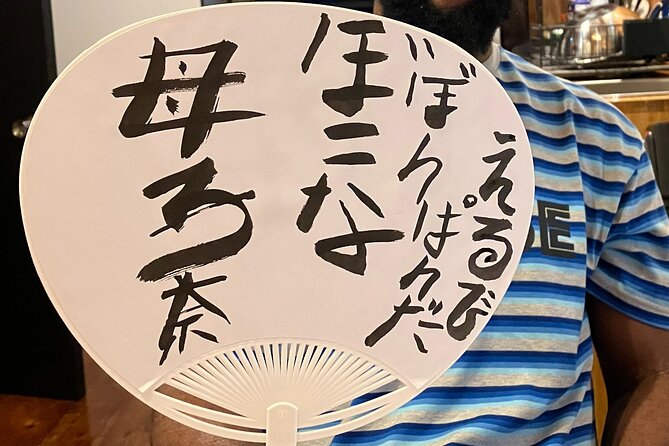
Your name becomes art in 90 minutes. In Tokyo, this Shodo calligraphy experience teaches you the basics, helps you practice controlled brush lines, and guides you as you write your name in Japanese or a kanji word. I loved the close, calm coaching from teachers like Sachie and Zuisen, and I also liked that you leave with a take-home autograph board. One thing to consider, the class space can feel like it is part of a hostel or boarding-house setup, so you may hear everyday activity around you.
What makes this workshop especially practical is that it fits neatly into a day you are already planning around Asakusa and Ueno. You meet near Iriya Station, and you get a focused lesson that moves from posture and brush basics to writing real characters, not just watching someone else work. It is also capped at a maximum of five people, so you are not stuck in a big group where you never get corrected.
You do not need previous calligraphy skill to participate. The lesson is designed so most travelers can join, and the experience includes the calligraphy supplies. If you want a meaningful souvenir that looks like it belongs in your trip photo album, this is a strong pick.
Key highlights you will care about
- Small-group lesson (max 5) with hands-on coaching
- Write your name or a kanji word, guided step by step
- Learn brush basics, including posture and how to form lines
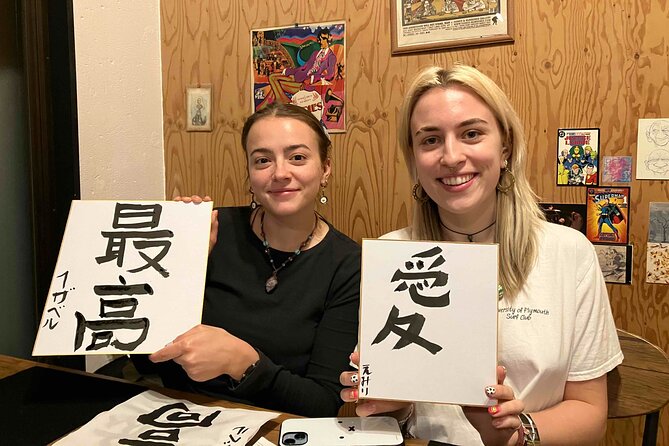
- Take home an autograph board with your finished work
- Meet near Asakusa and Ueno, about a 5-minute walk from Iriya Station
A 90-minute Shodo class close to Asakusa and Ueno
This experience is a tight, satisfying 1 hour 30 minutes, and that matters in Tokyo. You get enough time to actually learn what you are doing, not just dabble for five minutes and call it culture. The class is small, with a maximum of five travelers, so the teacher can adjust how you hold the brush and how you pace each stroke.
Location is another real advantage. The meeting point is Tokyo Iriya Shodo Club in Taito City, in the Iriya area. You are also close to Asakusa and Ueno, which makes it easy to pair with sightseeing you would do anyway. And it is conveniently near public transportation, with Iriya Station a short walk away.
One detail I appreciate is the mobile ticket. It keeps things simple once you arrive. You also return to the meeting point at the end, which reduces the awkward question of how to get out after your lesson.
A few more Tokyo days worth comparing
- Mt Fuji and Hakone 1-Day Bus Tour Return by Bullet Train
★ 5.0 · 26,383 reviews - 1-Day Tokyo Bus Tour
★ 5.0 · 14,250 reviews - Tokyo: TOKYO SKYTREE® Admission ticket
★ 4.5 · 11,192 reviews
What I would plan around it
If you want this experience to feel unhurried, I would schedule it when you are not racing across Tokyo for transfers. It is short, but calligraphy requires concentration. When you are tired, your strokes tend to get tense, and nobody wants that.
First you get the fundamentals: posture, brush grip, and line control
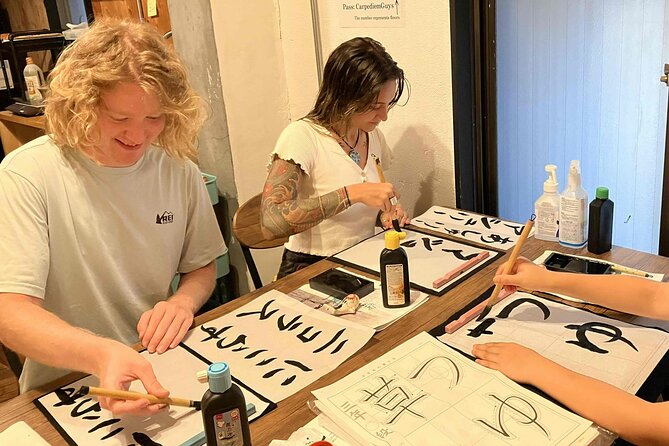
Shodo is not just about making pretty characters. The lesson starts with the physical basics, and that is where most people notice the biggest learning curve. You learn how to hold the brush, how to set your posture, and how to draw lines with control.
This is where the small group setup really pays off. In calligraphy, minute changes matter. A brush held at the wrong angle can make a stroke too thin, too fat, or unstable. Posture also affects how steady your hand feels. That is why a patient teacher helps you correct what you are doing early, rather than letting bad habits grow.
From the way the classes are described, you are not left with vague instructions. You practice shapes and basic components that later turn into characters. By the time you are writing a word, you are working with technique you already tested on paper.
Why the fundamentals are worth your time
You might think you are signing up to write a kanji character right away. But learning how to make a clean line is what turns your result from shaky and random into something that actually reads as calligraphy. It is the difference between drawing a character and writing it.
Same corner of Japan, a different kind of day:
- Tokyo: teamLab Planets TOKYO Digital Art Museum Entry Ticket
★ 4.6 · 9,779 reviews - Mt Fuji & Hakone Cruise, Drum Show Bullet Train 1 Day from Tokyo
★ 4.0 · 7,413 reviews - Tokyo: Sumo Show Experience with Chicken Hot Pot and a Photo
★ 4.8 · 6,678 reviews - Tokyo: Shinjuku Food Tour (13 Dishes at 4 Local Eateries)
★ 5.0 · 6,603 reviews
Writing your name in Japanese, plus the fun option of a kanji word
The core of the workshop is writing something personal. You can write your name in Japanese, or you can write your favorite word in kanji. That flexibility is great because it helps you choose what feels meaningful, not just what the lesson assumes.
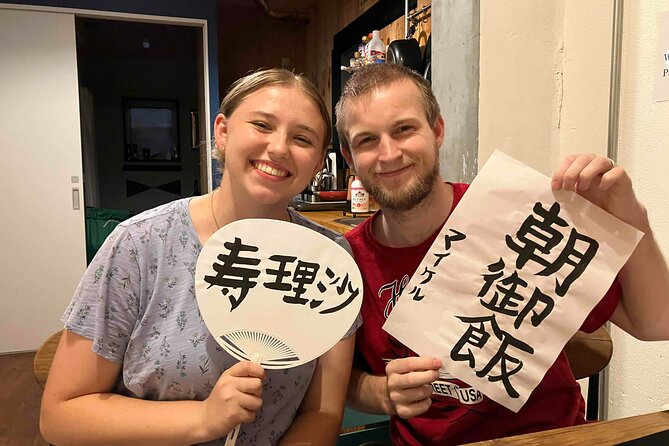
In practice, people often start with their name because it is quick to connect to. One review-style highlight was someone writing their name in katakana calligraphy, and seeing an automated tool recognize it correctly. That is a nice reminder that you are not just making art for decoration. You are learning forms that map to real writing systems.
For kanji, the lesson can get more challenging, and that is part of the appeal. One memorable example involved writing a more complex word, something with characters that are not simple to look at on your first try. The teacher approach in that setting matters, because complexity is easier when you get clear step-by-step guidance.
How to choose what you should write
- If you want an easier win, start with your name and your preferred script.
- If you want a more personal project, pick a kanji word that you actually care about.
- If you are not sure, ask during the lesson, and pick based on what you feel comfortable tracing and repeating.
The calligraphy reality check: hiragana, katakana, and kanji all feel different
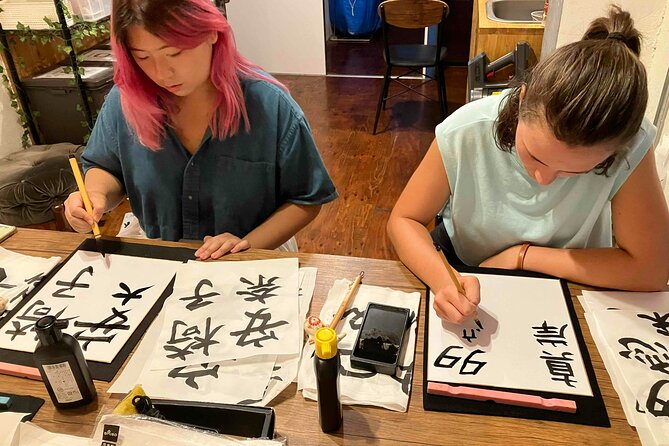
A lot of visitors come to Shodo expecting a single style. This workshop sets you up to notice that Japanese writing systems each have their own character and rhythm.
From the experience descriptions and outcomes, you can work across hiragana, katakana, and kanji depending on what you choose to write. Even if you only pick one script for your final piece, you will still see how the teacher approaches different forms. That is useful because it changes how you see Japanese text once you leave. You start spotting why certain characters look the way they do, and why they feel expressive even before you understand every meaning.
The lesson also emphasizes basic shapes and components. Those building blocks help you see characters as constructed, not magical. That makes it feel less intimidating and more doable.
A practical tip for your first attempt
Expect your first versions to be imperfect. The goal is progress and correct technique, not perfection. When you keep going through practice strokes, the character starts looking more controlled. That is usually when people get excited about their results.
Taking home your autograph board (and why it feels better than a postcard)
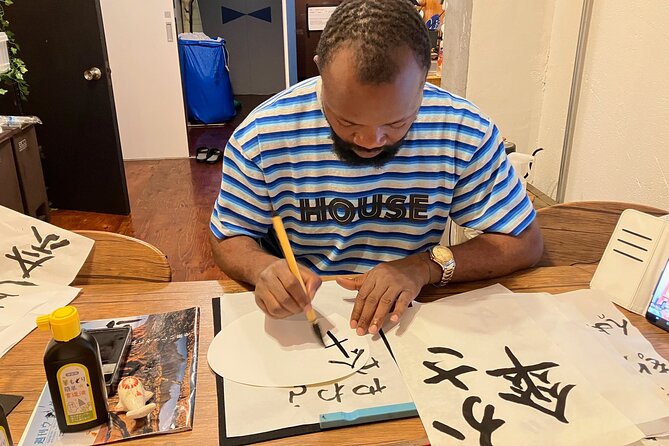
You do not just leave with a souvenir photo. You take home your own finished work on an autograph board. In other accounts, the class also resulted in a favorite-word piece on cardboard paper, which reinforces the same idea: you end with something you made.
This matters because the souvenir quality is tied to your effort during the lesson. If you picked your name in Japanese or a word in kanji, the final board is personal. It also works as a functional memory, not just decoration. You can show it to friends and explain what you chose and what you learned, which is much more satisfying than a generic store-bought trinket.
How to make it last
You will likely be handling ink and paper during the session. After the class, treat your board gently until it fully dries. If you plan to carry it in your bag right away, put it in a protective spot where it will not get crushed.
Your teachers drive the vibe, Sachie and Zuisen set the tone
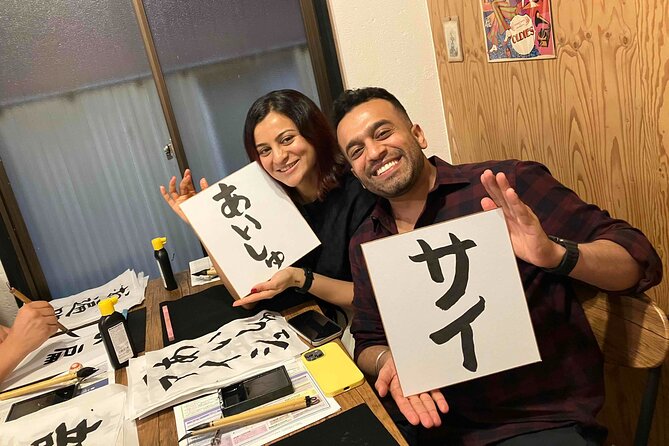
The most consistently praised element in accounts of this experience is the teaching style. People mention patience, friendly guidance, and the ability to explain clearly in English.
Names like Sachie and Zuisen show up in standout accounts, and that tells you the teacher quality is not random. A patient teacher helps you slow down and shape strokes correctly. They also help if you are nervous about making mistakes, especially if you are writing a word that feels too advanced for your first attempt.
Another detail that comes through is how the class can feel personalized. One person described having a solo class, which is the ideal scenario because every correction can go directly onto your paper. Even when the group is small, you still benefit from being seen and adjusted.
What you should do to get the best lesson
Come with a clear plan for what you want to write, even if you change your mind on the spot. And when the teacher corrects your posture or brush grip, treat that moment like the lesson turning point. Those changes often improve your final character more than anything else.
Where the class happens: hostel or boarding-house classroom energy
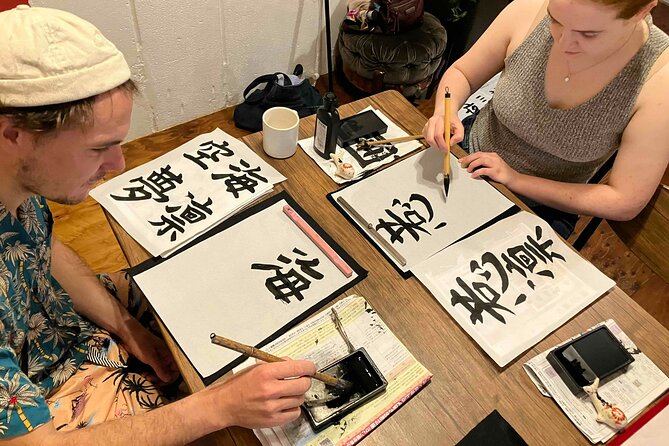
One possible drawback shows up clearly: the teaching space can have the feel of a hostel or boarding-house environment. In at least one case, the lesson was interrupted by co-residents doing everyday tasks like cooking and laundry during class time.
This does not mean the experience is chaotic. But it does mean you should go in with realistic expectations. If you are sensitive to noise or interruptions, you might want to arrive with a calm mindset and assume the environment may be active.
If you are arriving and wondering what to do, one practical hint is that you may need to ask inside where the workshop space is located. That is normal for small local facilities, and it saves you from wandering around outside.
How to make the setting work for you
If background activity distracts you, focus on the rhythm the teacher guides you through: stance, brush grip, stroke practice, repeat. Concentration is your best filter.
Price and scheduling: is $33.03 good value?
At $33.03 per person, this workshop is priced for a short, skill-based experience that includes supplies and a take-home piece. The value comes from four places, not just the cost:
First, the group size is small, with a maximum of five. Second, you receive hands-on instruction, including corrections. Third, calligraphy supplies are included, so you are not paying extra for materials. Fourth, you leave with a finished board you made.
Booking timing is also relevant. The experience is often booked about 27 days in advance on average. That suggests it is popular enough that you should not wait until the last minute, especially if you have specific dates and are combining it with Asakusa or Ueno plans.
How long should you leave in your day
Because it is about 1 hour 30 minutes, it works as a morning or early afternoon activity. If you are doing heavier sightseeing later, try not to stack it with another demanding tour that requires lots of standing. Calligraphy asks for focused sitting and steady attention.
Making the most of it near Iriya Station
This experience places you in a neighborhood you can pair with classic Tokyo stops. Since it is close to Asakusa and Ueno, you can do an efficient route: sightseeing in the area, then a lesson you can walk to.
To keep the day smooth, I would build in a buffer for transit. Small delays can happen, especially if you are new to the station layout. Once you arrive, the workshop is a short walk from the station, so you can avoid long commutes.
A simple day plan that fits
- Morning or early afternoon: visit Asakusa or Ueno
- Midday: walk to Iriya for your Shodo class
- After: continue exploring nearby streets with your new souvenir in mind
Who should book this Shodo experience
This is the kind of activity that works for many types of visitors:
- First-timers who want real instruction and a clear starting point.
- Solo travelers who like calm, focused activities.
- Couples or small groups who want something different from typical sightseeing.
- People who want a souvenir with meaning, not just a photo.
If you enjoy learning skills, this class can be especially satisfying. The way the lesson moves from basics to writing your chosen word means you feel progress during the session.
If you are looking for high-energy entertainment, this is not that. This is quiet, careful, and focused. But for the right traveler, it is exactly the point.
Should you book this calligraphy class in Tokyo?
Yes, if you want a small-group, hands-on Shodo experience with clear instruction and a take-home autograph board. The strongest reasons to book are the consistent emphasis on patience and helpful teaching, plus the fact that you finish with work that is genuinely yours.
My one caution is the location feel. If you are very noise sensitive, keep in mind the class may take place in a hostel or boarding-house style space where normal daily life can intrude. If that would bother you, consider booking a time when you expect a quieter environment, and mentally prepare to focus on your own practice.
If you want a memorable Tokyo moment you can bring home and explain, this is a very good use of 1 hour 30 minutes.
FAQ
How long is the calligraphy experience in Tokyo?
It lasts about 1 hour 30 minutes.
Where do I meet for the Shodo experience?
You meet at Tokyo Iriya Shodo Club in Taito City, Iriya, near Iriya Station.
How much does the experience cost?
The price is $33.03 per person.
What does the lesson include?
Calligraphy supplies are included, and you learn the basics of holding the brush, posture, and drawing lines.
What can I write during the lesson?
You can write your name in Japanese or a favorite word in kanji.
Is there a group size limit?
Yes. The experience has a maximum of 5 travelers.
Do I take something home?
Yes. At the end of the lesson, you can take home an autograph board with your own work.
Do I receive a mobile ticket?
Yes. The experience uses a mobile ticket.
What is the cancellation policy?
You can cancel for free up to 24 hours in advance for a full refund. If you cancel less than 24 hours before the start time, the amount paid is not refunded.
Fresh options around Tokyo
- Tokyo: Nikko Kegon Falls Lake Chuzenji Toshogu Temple & More★ 4.9 · 12 reviews
- Tokyo: Samurai History Walking Tour★ 5.0 · 12 reviews
- Harajuku: Kawaii Fashion and Pop-Culture Tour★ 4.7 · 12 reviews
- Tokyo: Mt. Fuji & Lake Kawaguchi Instagram Full Day Trip★ 4.1 · 12 reviews
- Shibuya Tokyo: Modern Kintsugi Workshop in Shibuya★ 5.0 · 12 reviews
- Tokyo: GTR Guided Daikoku Experience at Night★ 5.0 · 12 reviews
- Tokyo: Daikoku JDM Car Culture Tour★ 4.6 · 12 reviews
- Mt Fuji Private Day Trip from Tokyo with English speaking driver★ 5.0 · 13 reviews
Tokyo Tours, compared.

Mt Fuji and Hakone 1-Day Bus Tour Return by Bullet Train
Read our review →


teamLab Planets TOKYO Digital Art Museum Entry Ticket
Read our review →
Mt Fuji & Hakone Cruise, Drum Show Bullet Train 1 Day from Tokyo
Read our review →
Sumo Show Experience with Chicken Hot Pot and a Photo
Read our review →
Shinjuku Food Tour (13 Dishes at 4 Local Eateries)
Read our review →