
Reviewed · CYCLING TOURS
South Kyoto in a Nutshell: Gentle Backstreet Bike Tour!
Kyoto looks different at bike speed. This gentle backstreet ride threads together several of south Kyoto’s best stops, with a guide handling the route so you can focus on scenery, photos, and not studying a map. You’ll spend the morning moving through quiet streets and famous areas like Fushimi Inari-taisha at a pace that feels like sightseeing, not sprinting.
Two things I really like are the practical inclusions, including a high quality Cannondale bike plus a helmet, and the way the guide helps you get through the hardest crowd moments without wasting time. On top of that, the route is built around great photo chances, especially when you’re near major landmarks but still need a smarter line than the one everyone else is taking.
One thing to consider is that time can feel tight if you want long photo stops, especially around the big draw areas. The tour moves as a group, so you’ll need to choose your moments and keep moving when it’s time to roll.
Key highlights at a glance
- Small group size (max 8) means you’re not lost in a herd when crossing streets or pausing for photos
- Cannondale bike, helmet, and bottled water are included, so you travel light
- Backstreet routing helps you see real neighborhoods plus major sights without the same slowdown
- Fushimi Inari-taisha crowd strategy lets you enjoy the shrine without getting stuck in the worst bottlenecks
- A calm, gentle pace designed for people who are comfortable riding a bike (minimum age is 13)
- Several top Kyoto stops clustered together means less transit time and more time at the sights
Why a south Kyoto bike tour beats the usual shuffle
A half day on a bike is one of the easiest ways to get oriented in Kyoto. You trade awkward walking distance and station-to-station plans for forward motion, with short sight stops that still feel unhurried.
This tour is built for efficient sightseeing without turning into a checklist. You hit big names like Gion and Fushimi Inari-taisha, but the route also leans into quieter backstreets. That matters, because Kyoto can feel chaotic around the biggest attractions, even early in the day.
And since you have a guide, you also skip the mental load. No map wrestling at every intersection. No guessing which side street leads to the next calm moment. Just ride, pause, look, and listen.
More Bike Tours in Kyoto
- Hidden Kyoto E-Biking tour
★ 5.0 · 1,843 reviews - Bike Tour Exploring North Kyoto plus Lunch
★ 5.0 · 1,087 reviews - Arashiyama Bamboo Forest & Hidden Gems Bike Tour (Early Bird)
★ 5.0 · 613 reviews
The morning start at Cycle Kyoto, plus what you should expect
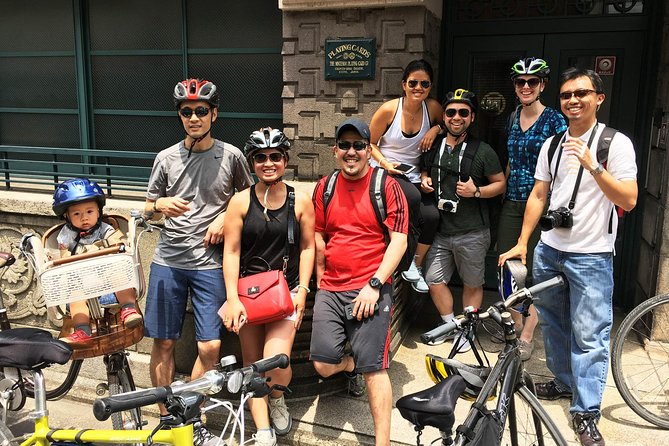
Your tour begins at Cycle Kyoto, at 7 Higashikujō Nishisannōchō in Minami Ward. The start time is 9:00 am, and you return to the same meeting point when the ride wraps up.
At the shop, you meet your guide and the other riders, then get your bike fitted. Expect this early part to be practical, quick, and focused on comfort and safety. You’ll also get water, which is handy because the ride covers multiple areas and you do not want to spend your morning hunting for a bottle.
The ride setup is one of the best parts of booking a guided bike tour instead of renting on your own. You remove the guesswork, from choosing the right bike size to learning how the group moves through traffic.
Nishi Honganji, a calm religious stop with big wooden scale
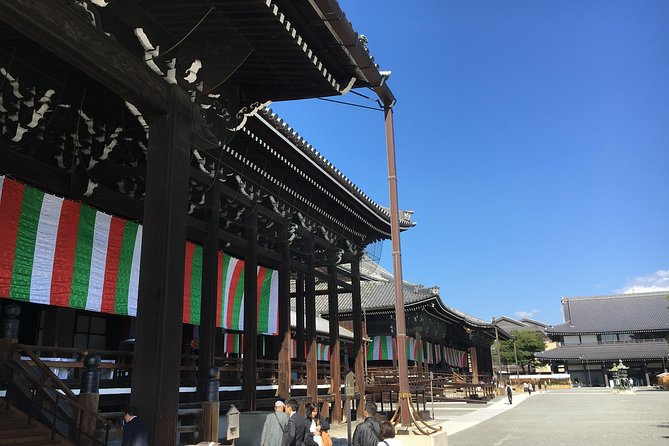
Next you head to Nishi Honganji. This is one of the least visited religious sites in Kyoto, and it’s also famous for its scale, including one of the largest wooden buildings in the world.
This stop works well because it resets your brain. After you’ve been riding and moving through city streets, you arrive at a space that feels grounded and reflective. Even if you only spend about 15 minutes here, it’s the kind of place that helps you understand Kyoto beyond the photo hotspots.
What I’d watch for here is pacing. A short visit means you should look for one or two key details rather than trying to see everything. If your guide points out features, follow that direction, because scale like this can be hard to read on your own in a limited time window.
Also, the tour notes list admission as free for this stop, which is a nice budget win. It’s one less thing to think about while you’re planning your day.
Takase Canal on two wheels: a quiet photo corridor
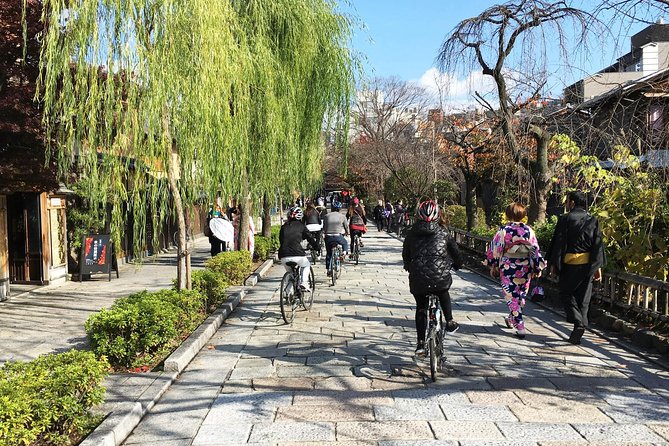
One of the best stretches on this ride is the time along Takase Canal. You follow the canal by bike while learning about its place in Kyoto’s history and getting photo opportunities along the way.
This is the part of the tour that feels most like a local commute, just with better timing. Instead of staring at a map, you glide along a linear route where the scenery keeps coming. The canal also creates natural breaks where you can slow down mentally and take pictures without feeling like you’re standing in a crowd line.
A practical tip: keep your phone or camera accessible. The canal looks good from the bike, and it also gives you chances to frame shots with bridges and canal edges. If you know you get slow at photo stops, decide your two or three must-have angles before you start this segment.
Admission is listed as free for the tour stops shown, and Takase Canal itself is the kind of setting where you also do not have to rush through ticketed spaces.
Same corner of Japan, a different kind of day:
- PERFECT KYOTO 1-Day Bus Tour
★ 5.0 · 13,518 reviews - Kyoto: Fushimi Inari, Kinkakuji, Bamboo Grove 1 Day Bus Tour
★ 4.8 · 4,316 reviews - Kyoto: Tea Ceremony in a Traditional Tea House in Kiyomizu
★ 4.9 · 3,519 reviews - Kyoto Geisha Walking Tour: Gion District & Hidden Gems
★ 4.7 · 3,273 reviews
Gion without the lost-in-the-crowd feeling
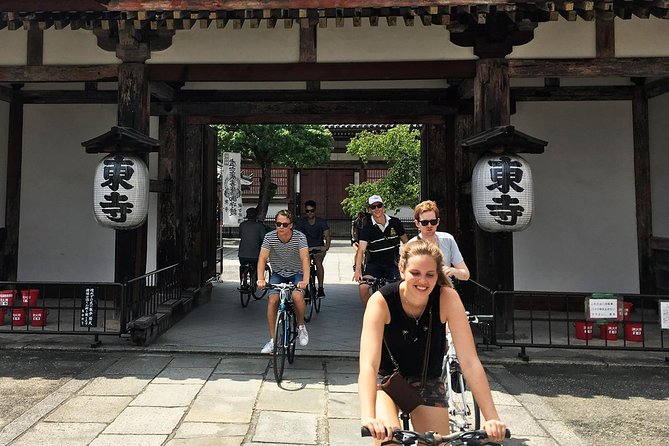
Then you roll into Gion, Kyoto’s famous geisha district. This is the area most people picture when they think of Kyoto, and it can also be the trickiest place to enjoy without feeling like you’re stuck in foot traffic.
Here, the bike approach helps. You can cover ground faster than walking, so you get to see more of the neighborhood without spending your whole time dodging slow-moving crowds. Your guide also helps you understand what you are looking at, including the idea of a hidden world that feels close up but not intrusive.
You spend about 15 minutes here. That is enough time for a stroll moment and photos, but not enough time to wander forever. If you want extra soaking time, your best move is to communicate that gently to your guide when you pause. Some flexibility depends on crowd levels and how the group is doing, and the tour is designed to adjust based on those realities.
This is also a great area to practice Kyoto etiquette. Follow your guide’s instructions for pedestrian behavior and bike movement. One reason people love this tour is that the leaders tend to give clear guidance, so you can feel safe while still experiencing the neighborhood close to street level.
Tofukuji Temple: fast, scenic, and easy to fit into a route
After Gion, you head to Tofukuji Temple. You spend about 5 minutes at this stop, which sounds brief until you remember what you’re there for: a spectacular view from the bridge and spacious grounds.
This stop is valuable because it’s visually strong, and it’s quick. If you have limited time in Kyoto, you still get a major temple moment without losing half your day.
The bridge view is the key. With only a short window, prioritize the best angles your guide suggests. If you try to spread yourself too thin, you can miss the whole point of a short stop: seeing the most striking view before you move on.
Also, the tour lists admission as free for this stop. That means your time and energy go toward the experience, not paperwork or ticket queues.
Fushimi Inari-taisha: the shrine, but with a smart route through crowds
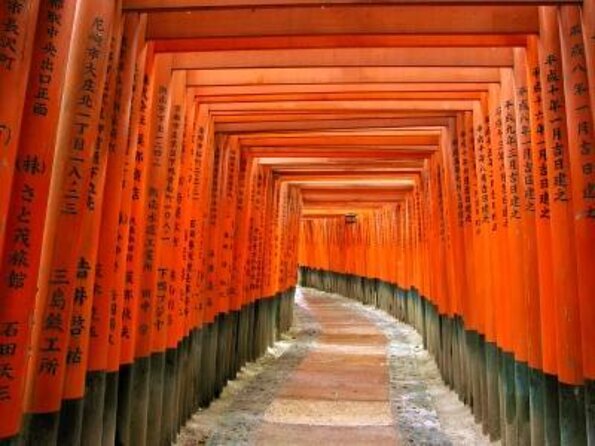
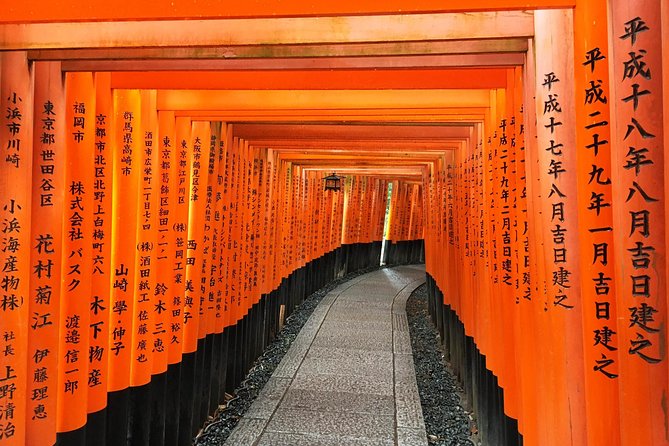
Finally, you reach Fushimi Inari-taisha Shrine. This is Kyoto’s most visited attraction, and it can be tough to navigate when everyone is trying to do the same thing at the same time.
The big win here is the guide’s crowd strategy. Instead of following the same obvious path everyone else is using, the tour is designed to pick routes through the crowds so you can enjoy the shrine more comfortably. This is the kind of difference that changes your day from stressful to enjoyable.
Your time here is about 25 minutes. That’s enough time to take in the scale and get photos, especially if you avoid stopping in the busiest chokepoints for too long. You’ll likely see the shrine from a few angles as you move, and the back-and-forth motion is helpful, because Inari is all about visual rhythm.
One more practical thought: Fushimi Inari is popular for a reason, but popularity means delays. Bike access is not about cutting a line, it’s about movement plus guidance. So keep a calm pace, listen for your guide’s instructions, and plan to capture photos quickly, then enjoy being there.
Price and value: what $79.59 gets you in real terms
The tour costs $79.59 per person and runs about 3 to 4 hours. For Kyoto, where you can easily spend time and money hopping between areas, this format can be strong value.
Here’s why the number makes sense:
- Bike and helmet are included, so you do not pay extra for rental, and you avoid sizing hassles
- Bottled water is included, which keeps the morning comfortable
- A high quality Cannondale bike is provided, which matters because a good ride makes a big difference on a multi-stop morning
- Multiple major sights are grouped together, which cuts transit time and planning effort
Also, the tours’ featured stops list admission as free, which helps your budget stay predictable. Even if you only see one or two of these areas on your own, guided route planning can still save time, and time is the currency you spend in Kyoto.
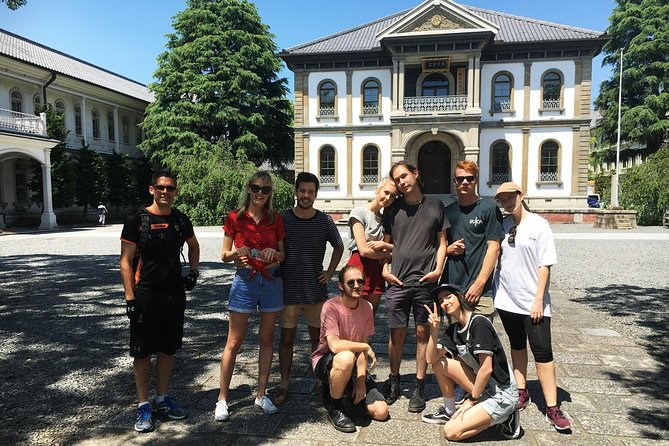
Lastly, the group size is capped at 8. That matters for value because it affects how often the guide can pause, how easily you can hear explanations, and how smooth the rides feel when you’re stopping or crossing streets.
How easy is the ride, and what to wear
This is a gentle backstreet bike tour, but it is still a bike tour. You need to be comfortable riding a bike, and the minimum age is 13.
In practice, that means you should feel confident:
- starting and stopping smoothly
- riding in city traffic patterns at low speed
- keeping control while the group moves
The terrain is mostly in side streets and built around manageable pacing. In hot weather, you’ll still get warm from movement, so light layers help. In cooler weather, you’ll appreciate that you are riding, not just standing in lines.
For clothing, I’d stick to practical shoes with grip. Also bring something for sun or rain if weather changes quickly. The tour requires good weather, so be ready with a backup plan for the day you booked.
If you are the type who likes to stop for every small photo, plan to choose strategically. The ride is designed for several stops, so a few well-timed photos beat a long pause that breaks the flow.
Who this tour is best for, and who might want another plan
This tour fits best when you want:
- a guided overview of south Kyoto without crisscrossing the city on your own
- a way to see Gion and Fushimi Inari without spending hours stuck in dense foot traffic
- a bike morning that is active but not an all-day ordeal
It’s also a great choice for first-time visitors because the route gives you a sense of how different Kyoto feels in different neighborhoods. You get temple scale, canal calm, and classic old-district atmosphere in one smooth block.
It might not be ideal if you have zero desire to ride. Even though the pace is gentle, you still need bike comfort and you need to stick with the group timing.
If you want a tour that turns into long wandering breaks at every stop, you may feel the time pressure at places like Gion and Fushimi Inari. The tour is built around efficient viewing, not extended free time.
Should you book this South Kyoto bike tour?
Yes, if your goal is a smart, low-stress introduction to south Kyoto with included bike support and guided routes through the most difficult crowd moments. The combination of Nishi Honganji’s scale, Takase Canal’s calm, Gion’s street-level atmosphere, and Fushimi Inari’s iconic shrine makes this a strong “see a lot, don’t waste time” morning.
I would especially recommend it if you dislike maps, hate figuring out transit between distant areas, or want a more local feel than you get from big bus loops. Just be honest with yourself about one thing: if you want to linger for photos for a long time, you’ll need to work with the group timing.
FAQ
How long is the South Kyoto bike tour?
The tour lasts about 3 to 4 hours.
What time does the tour start?
The start time is 9:00 am.
Where do we meet and where does the tour end?
You meet at Cycle Kyoto, 7 Higashikujō Nishisannōchō, Minami Ward, Kyoto, 601-8003, Japan. The tour ends back at the same meeting point.
What’s included in the price?
The price includes a high quality Cannondale bike, a helmet, bottled water, and use of the bicycle.
Are admission fees included for the stops?
The tour lists admission as free for the featured stops.
How big is the group?
The tour has a maximum of 8 travelers.
Do I need any special riding experience?
Most travelers can participate, but you must be at least 13 years old and comfortable riding a bike.
FAQ
Is the tour dependent on weather?
Yes. The experience requires good weather, and if it is canceled due to poor weather you will be offered a different date or a full refund.
Fresh options around Kyoto
- Kyoto Aquarium Admission Ticket★ 4.7 · 12 reviews
- Kyoto Gion Photoshoot – Private Session | Pro Photographer★ 5.0 · 12 reviews
- Gyoza Cooking Class in Kyoto: Traditional Japanese Dumplings★ 5.0 · 12 reviews
- Kyoto: Guided Food Tour with 12 Dishes & 3 Drinks★ 5.0 · 12 reviews
- Kyoto: Avoid the Crowds at the Hidden Gems of Arashiyama★ 4.9 · 13 reviews
- Kyoto Early Bird English Tour: Gion & Higashiyama(Private opt)★ 5.0 · 13 reviews
- Otsu-e Folk Art Workshop & Local Culture Walk Near Kyoto★ 5.0 · 13 reviews
- Kyoto, Osaka, Nara Full Day tour by Car English speaking Driver★ 3.5 · 13 reviews
Cycling Tours, compared.
3h Tokyo E-Bike Tour: Hidden Gems, and Local Life with guide
Read our review →
Arashiyama Bamboo Forest & Hidden Gems Bike Tour (Early Bird)
Read our review →
Hiroshima in a Nutshell: Morning Bike Adventure
Read our review →Browse the lists this tour appears in